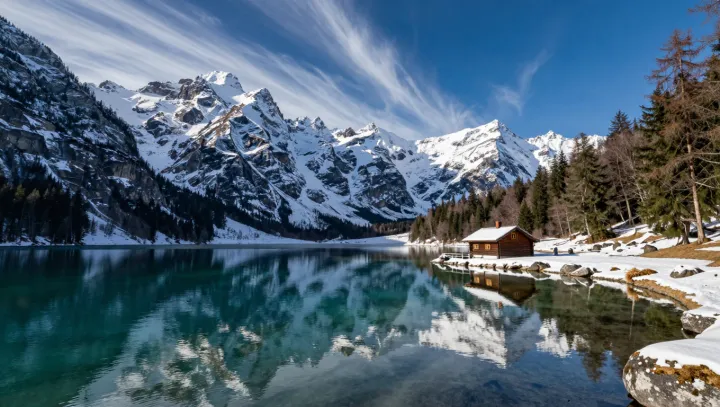
This turquoise stillness is anything but gentle. The almost unreal color signals that rock is being ground to dust by ice and gravity, then piped into the basin as a fine mineral load. Microscopic grains of silt, often called rock flour, stay in suspension because Brownian motion and weak turbulence counteract their slow settling, turning the entire water column into a milky optical filter.
Calm beauty here depends on violent history. The basin’s depth and shape reflect long episodes of isostatic uplift in the Alps and repeated carving by valley glaciers that exploited joints and faults in the bedrock. As ice advanced and retreated, subglacial abrasion and plucking excavated overdeepened hollows, later flooded by meltwater that now seems pristine. Yet every glint of light off the surface carries a signal from that excavation, because selective scattering by suspended particles enhances blue and green wavelengths while absorbing and diffusing reds.
Clarity, too, is a hard‑won illusion. When inflowing streams slow at the lake margin, heavier clasts drop out, while the finest particles remain in colloidal suspension, controlled by Stokes settling velocity and fluid shear. Periodic pulses of turbidity after storms or rapid melt record short bursts of erosion higher in the catchment, superimposed on the longer arc of tectonic uplift that keeps creating new relief to erode. What looks like a flawless mirror is really an exposed cross‑section of Alpine time, written in grain size, mineralogy and light.