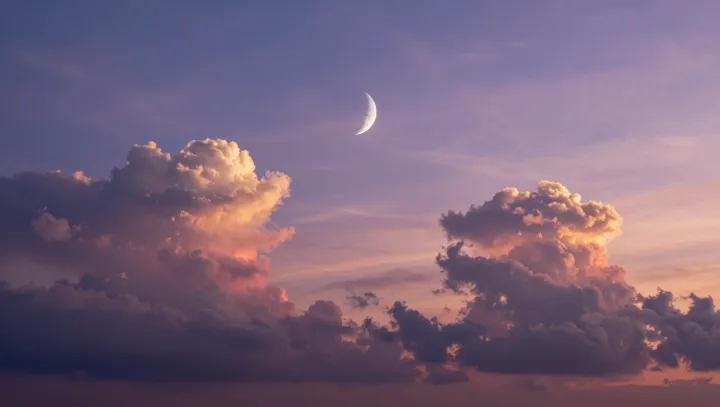
A fading strip of sunset can be more honest about the air than any daylight sky. Along the horizon, sunlight skims through the lowest troposphere, where aerosols and desert dust dominate Mie scattering and turn the band a dense, murky orange. Higher above that line, the glow thins and reddens, marking air where particulate loading drops and gas molecules take over the scattering budget.
Most observers misread the thin crescent moon as decoration, yet it is a hard diagnostic tool. The moon’s sunlit edge traces the geometry of the solar disk just below the horizon, so its position pins down the altitude slice of atmosphere that is still illuminated. Slightly above the dusty belt, residual yellow light reveals moist layers rich in water vapor, where Rayleigh scattering is weaker but absorption bands quietly erode blue and green wavelengths.
The most revealing layer sits even higher and looks almost unreal. A faint, steel-blue sheen well above the lunar arc can betray noctilucent or cirrus-type ice clouds in the upper troposphere and mesosphere, where subvisible crystals forward-scatter the last grazing rays. What appears as a simple color gradient is, in practice, a vertical cross-section: dust near the ground, vapor in the middle, tenuous ice ruling the top of the sky.