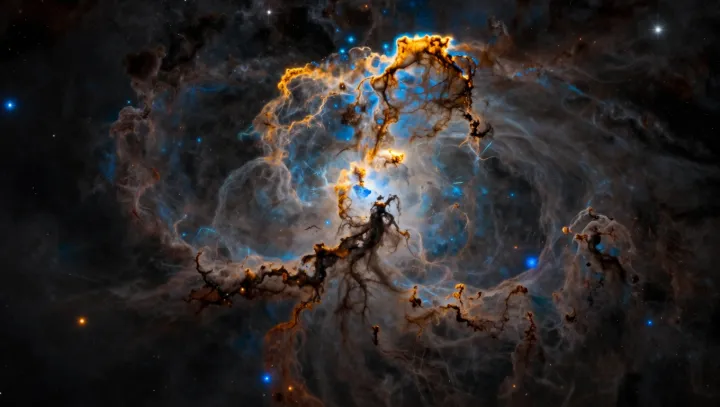
That faint gas is not weak at all; it is overpowered. In a bright nebula, every sparse atom sits inside a storm of high‑energy photons and shock waves from massive stars or a central compact object, so even a density lower than a laboratory vacuum does not protect it from constant excitation.
The key is that brightness tracks energy processing, not crowding. When ultraviolet radiation or fast particles strike hydrogen and heavier ions, they ionize the atoms, then radiative recombination and collisional excitation force those ions to emit specific emission lines, each line carrying away a packet of energy into space. Spread that process over a region light‑years across and the total photon flux can exceed that from millions of cooler, quieter stars packed nearby.
The gas acts less like a fog and more like a galaxy‑scale fluorescent bulb. Power comes from outside: stellar winds, accretion disks, supernova debris. The matter itself is thin, yet the volume is enormous, so the integrated luminosity rivals or beats whole star clusters even though any single cubic centimeter would look almost empty.