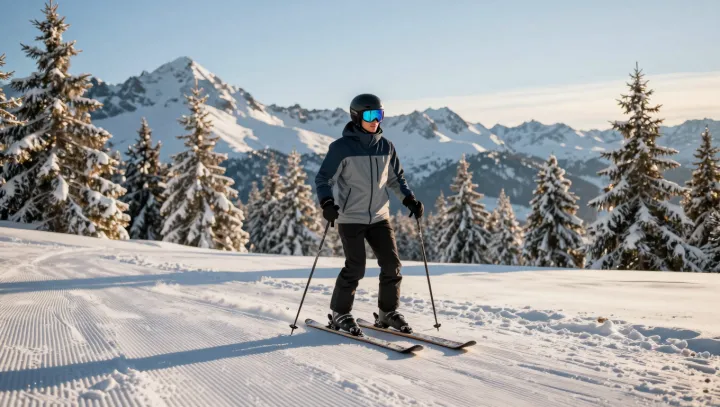
Blinding snow is not just uncomfortable; it is raw sensory noise that sabotages judgment. A skier’s helmet and goggles turn that chaos into a controlled data stream, giving the brain stable inputs it can actually parse. The tinted lenses first attack the main problem: brutal luminance and low contrast. By narrowing the spectrum and boosting edge contrast, especially between ice, powder and shadow, they give the visual cortex sharper gradients to work with, which restores depth cues that would otherwise vanish in a white sheet of glare.
Equally underrated is the way this gear edits motion itself. The helmet damps high‑frequency vibration and random head jolts, so the vestibular system in the inner ear receives cleaner signals about angular acceleration instead of constant micro‑whiplash. That stabilizes the link between semicircular canals and eye movements, a process known as the vestibulo‑ocular reflex, so the world stops smearing with every tiny bump. Meanwhile, the goggle frame and helmet shell manage airflow and temperature, reducing tear film disruption and corneal freezing, which keeps fixation sharp enough for the brain to triangulate moguls, trees and other skiers at speed with surprising precision.
The odd truth is that this kit does not add new senses; it subtracts bad data. By stripping away glare, jitter and freezing wind, the helmet‑goggle pair leaves a lean feed of light and motion. On that quieter channel, the brain can still run its old algorithms for estimating distance and velocity, even while the mountain itself stays brutally bright and cold.