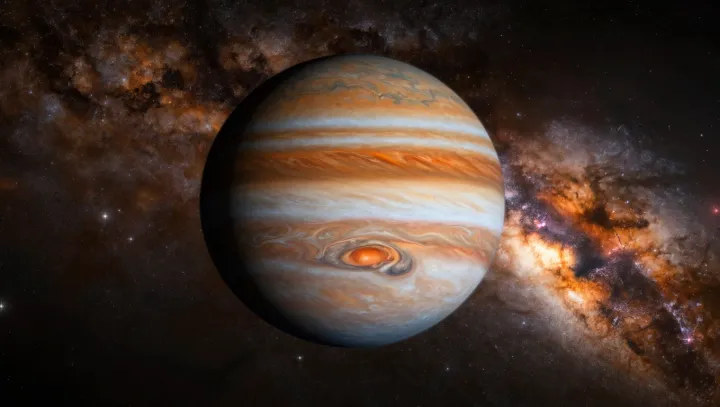
A storm that never hits ground should fade fast, yet Jupiter’s Great Red Spot keeps spinning, dwarfing Earth in the process. Anchored not to rock but to physics, this giant anticyclone feeds on the gas giant’s deep internal heat and the violent banded winds that surround it, turning an apparent weakness into a long‑term power source.
The real surprise is how little friction it faces. On Earth, hurricanes slam into continents, lose angular momentum, and die. Jupiter offers no solid crust, only a thick envelope of hydrogen and helium in near‑hydrostatic balance, so the storm’s kinetic energy is not rapidly drained into terrain. Instead, sharp zonal jet streams, with different velocities above and below the vortex, shear past its flanks and inject fresh vorticity, a process described by quasi‑geostrophic theory and barotropic instability models.
Longevity here is more about supply chains than anchors. Continuous convection from warmer layers below delivers heat, while radiative cooling from cloud tops sets up persistent temperature gradients that maintain pressure differences across the vortex. Turbulent eddies in the surrounding belts are not just noise; they are small storms that get absorbed, transferring momentum into the larger circulation. Over long spans, the Great Red Spot slowly shrinks and changes color, but its survival shows how a deep, low‑drag fluid system can keep a single storm alive far beyond any weather on Earth.