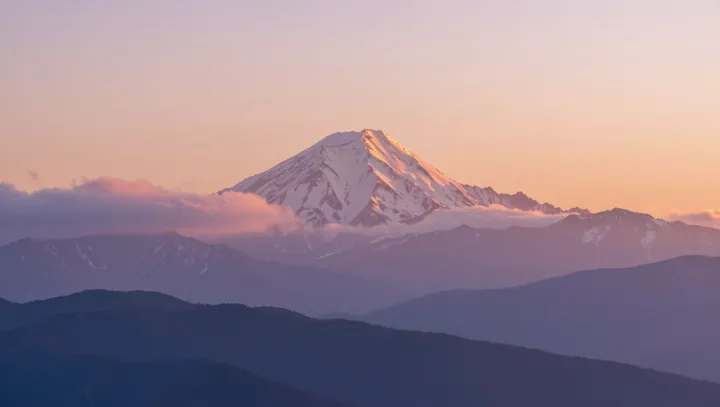
That glowing summit is not bright in power; it is bright in contrast. Against a darkening sky, even weakened sunlight, filtered by air, can punch above its weight on reflective snow. At low solar angles, light crosses a long path through the atmosphere, where Rayleigh scattering removes much of the blue and green, leaving a beam rich in red and orange wavelengths that human eyes register as intense warmth.
The stronger claim is this: the snow is not just lit, it is engineered by nature to amplify that last light. Snow has high albedo, so it reflects a large fraction of incoming radiation rather than absorbing it, and the ice crystals act as countless tiny mirrors that bounce those long wavelengths outward. Because the sun sits near the horizon, direct illumination hits only the upper slopes while valleys fall into geometric shadow, so the peak becomes the only surface still receiving direct short‑path rays, which heightens visual contrast even though the total irradiance is falling.
The real twist lies in perception, not physics alone. As global light levels drop, pupils widen, and the retina’s photoreceptors adapt, so that a modest flux of saturated red light appears almost theatrical against desaturated surroundings. The summit seems to flare brighter than midday, yet photometry would show less energy there, a reminder that the most striking light often arrives just as the day is running out of it.