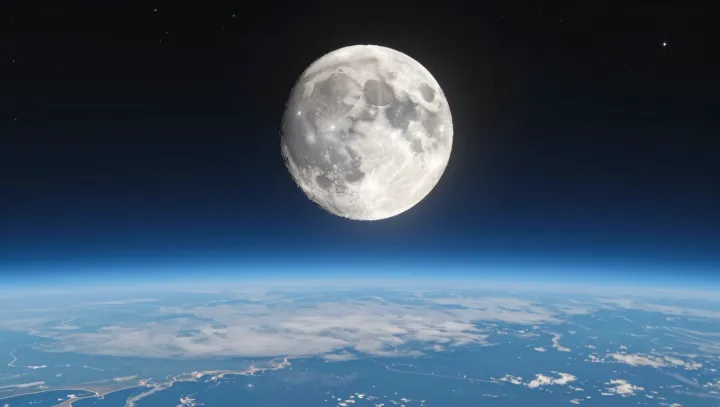
The far side of Earth rises toward a high tide not despite the Moon's weaker pull, but because of it. Gravity acts across the whole planet. The Moon pulls Earth's center more strongly than it pulls the ocean on the far side, leaving that water behind relative to the planet's center.
The distinction is everything. On the near side, lunar gravity pulls ocean water more strongly than it pulls Earth's center, drawing water toward the Moon. On the far side, the weaker pull means water accelerates toward the Moon less than the center does. This difference in gravitational acceleration, known as the tidal force, stretches the oceans along the Earth and Moon axis. In an idealized ocean covering the planet, that produces two tidal bulges, one facing the Moon and one facing away.
Real coastlines refuse such tidy symmetry. Continents interrupt the water's movement, while ocean depth and basin shape influence how tidal waves travel and when high water arrives. The Sun adds its own tidal force, strengthening or weakening the combined effect depending on its alignment with the Moon. Many shores experience two high tides during a lunar day, but some have only one, and others show mixed patterns. Beneath those varied rhythms lies a simple imbalance: the Moon pulls every part of Earth, but never quite equally. On the far shore, the water falls behind.