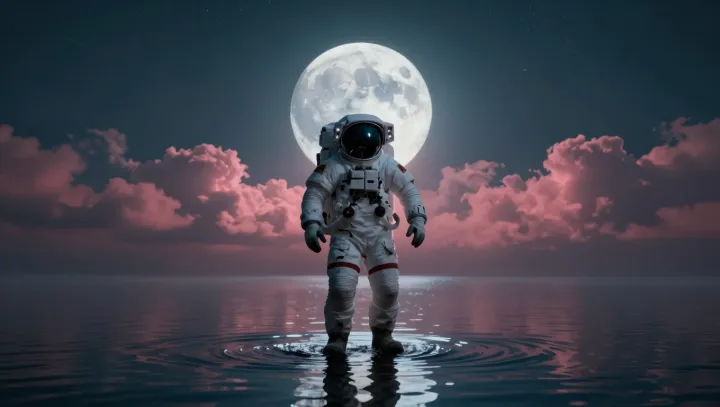
Lunar dust needs no wind to become a menace. In the surreal artwork, an astronaut stands before an enormous Moon, framed by clouds and watery reflections; on the actual Moon, the danger is less dreamy. Fine grains cling to suits and hardware, turning a walk into a problem that can follow crews indoors.
The grains are stubborn by nature. Formed as impacts pulverize rock, lunar dust has had little exposure to the weathering that rounds many particles on Earth, leaving some grains angular and abrasive. Electrostatic charging adds another complication: sunlight and the solar wind can charge particles and surfaces, influencing how dust moves and sticks. At close range, van der Waals forces also help grains adhere. Contact does the rest. Boots, tools and vehicle wheels disturb the surface, sending particles along paths that gravity eventually pulls back down.
The real cost is mechanical, not cosmetic. During Apollo missions, dust fouled suit joints, seals and equipment; astronauts also carried it into their spacecraft. Its rough particles can grind against moving parts, while deposits on surfaces can interfere with their intended function. Designers must contend with both adhesion and abrasion, using measures such as protective covers and dust removal techniques rather than assuming that a quick brush will solve everything. The artwork offers clouds and a mirrored Moon; the explorers who go there must reckon with what clings after the view has vanished.