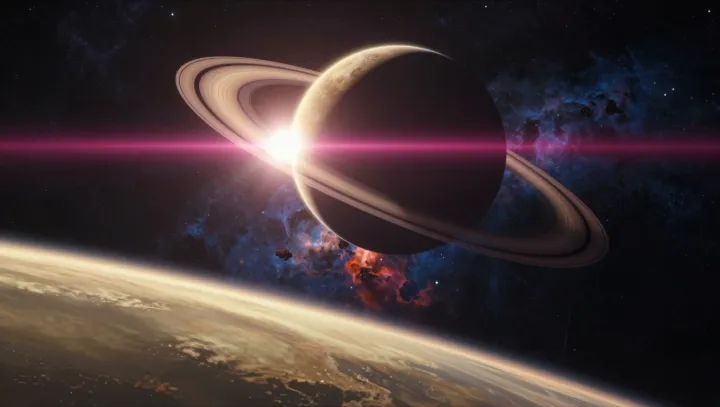
Saturn's rings are a triumph of disorder made flat. Countless particles, mostly water ice, circle the planet independently, yet together they form a disk so broad and thin that its proportions defy the familiar image of a solid hoop. Nothing holds it together like a rim.
The explanation lies in repeated collisions. Gravity keeps the particles in orbit, while impacts gradually reduce the random motions that carry them above and below the common orbital plane. The particles do not stop moving: each follows its own orbit, with those closer to Saturn generally traveling faster than those farther out. Order has a cost. Collisions convert some orbital motion into heat, allowing the disk to settle without requiring its countless pieces to march in lockstep. The main rings extend hundreds of thousands of kilometers across, but are typically only about ten meters thick.
Flatness, however, is not the same as stillness. Orbital resonances with Saturn's moons can open gaps or raise waves in the rings, while the planet's tidal forces inhibit large moons from forming within much of the ring region, known as the Roche limit. Jupiter, Uranus and Neptune have rings too, though their systems differ markedly in brightness and structure. Saturn's display is no fixed monument: particles migrate, collide and respond to their neighbors, making its apparent serenity a constantly negotiated condition. From afar, the ice seems to draw a single line around a world.