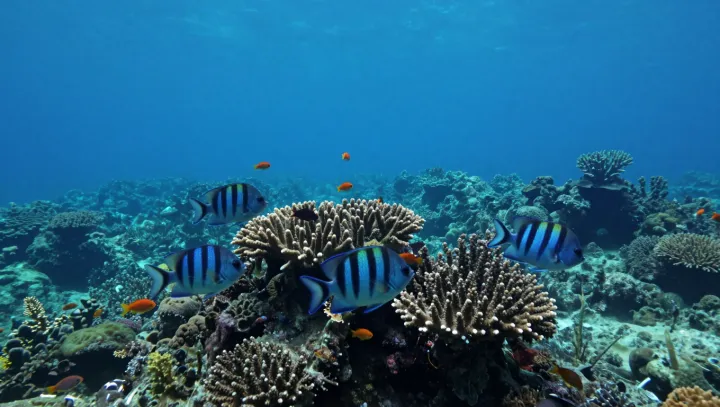
Bold stripes can make a reef fish harder to recognize, not easier. Against coral branches and shifting light, contrasting bands interrupt the visual boundary that tells a predator where a body begins and ends. The trick is context. A pattern that stands out in open water may disappear into the clutter of a reef.
The fish need not become invisible to gain an advantage. Disruptive coloration works by breaking up an animal's apparent outline, especially where dark and light markings meet the body's edge. A predator may see the bands yet struggle to assemble them into the shape of prey. Some reef fish carry a stripe across the eye, too, obscuring a feature that could reveal the head and the direction of escape. Recognition takes precious time. How well either tactic works depends on the observer's vision, the viewing distance and the surrounding pattern.
A reef makes a better accomplice than a blank canvas. Coral provides food and shelter for a diverse community, but its branches, shadows and patches of light also create a busy visual setting in which stripes can blend with nearby edges. Camouflage has limits. A fish crossing open water, or moving against a contrasting background, may be easier to detect; stripes can also serve other purposes, including communication between fish. Still, beneath the broken light, the apparent advertisement of a striped body can become a question a predator fails to answer in time.