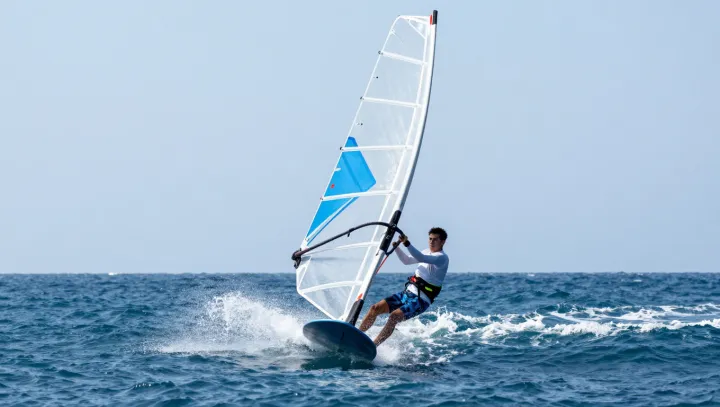
The wind is not a speed limit. A windsurf board can outrun the air that drives it, provided its sail and course turn that air into a force with a useful forward component. The trick is not to chase the wind directly, but to cut across it.
The sail behaves less like a parachute than a wing. As the board moves, it encounters apparent wind: the airflow created by combining the true wind with the airflow produced by the board's motion. Air moving around the curved sail creates aerodynamic lift, a force roughly perpendicular to that apparent wind. Some of that force pulls the board forward; some pulls it sideways. The fin and the board resist the sideways pull through their interaction with the water, while the rider leans back to balance the sail's pull. Speed changes the equation. As the board accelerates, the apparent wind shifts toward its nose, so the rider must adjust the sail to keep it working.
Sail angle is a matter of precision, not brute force. Turn the sail too far into the airflow and it can stall, losing lift as the flow separates; turn it too far away and it generates too little drive. The best angle varies with speed, course and conditions. A reach, with the board traveling across the wind or somewhat downwind, can let forward drive exceed drag even after board speed passes true wind speed. Directly downwind, that advantage disappears: as the board approaches wind speed, the apparent wind dwindles. At the edge of speed, the sail meets a wind of its own making.