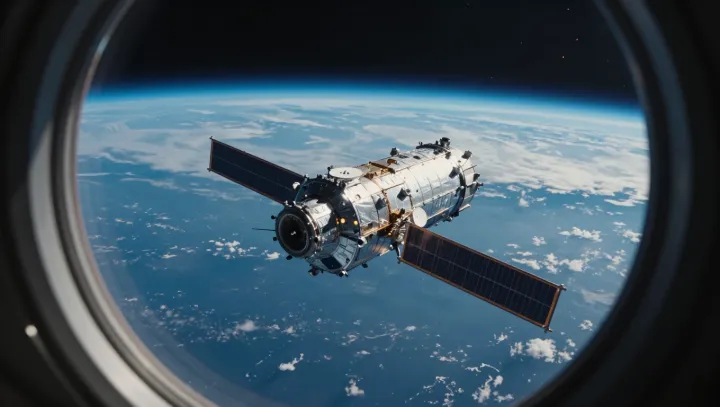
Weightlessness is not an escape from gravity. It is a consequence of falling. A spacecraft above Earth, its solar panels extended, remains under a powerful gravitational pull; at the altitude of the International Space Station, gravity is roughly 90 percent as strong as at Earth's surface. The absence of weight has a different explanation.
Orbit is a controlled surrender to gravity, not a victory over it. The spacecraft moves sideways so quickly that, as gravity bends its path toward Earth, the planet curves away beneath it. In free fall, the craft and everything inside accelerate together. A loose object does not press against a floor, and a person feels no supporting force from one. That missing pressure is what makes both appear weightless, even as gravity continues to shape their path. At station altitude, orbital speed is roughly 28,000 kilometers per hour.
The stillness inside is less perfect than it looks. Microgravity describes the small residual accelerations caused by atmospheric drag, machinery and other disturbances; it is not a claim that gravity has vanished. Solar panels supply electricity for onboard systems, but they do not hold the spacecraft aloft. Nor does orbit last forever without intervention: drag gradually robs a low orbit of energy, and propulsion can restore altitude. Above the curved horizon, the floating objects remain in Earth's grasp.