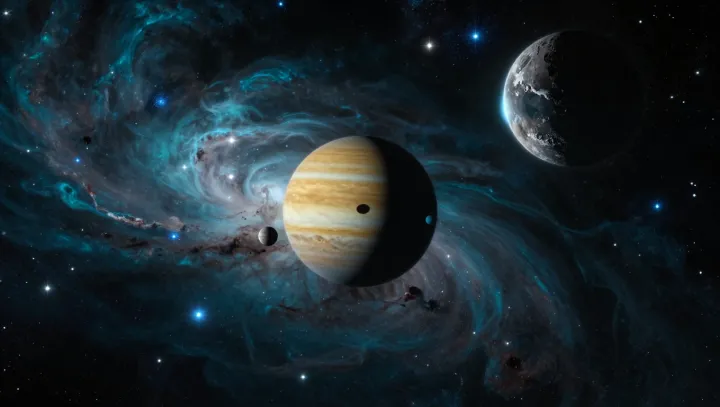
A moon does not need much starlight to keep an ocean liquid. The more interesting furnace may lie within: gravity from a giant planet can repeatedly flex an orbiting moon, turning mechanical energy into heat beneath its frozen surface. The ice is not merely a lid. It can slow heat loss, allowing water below to persist where the surface remains bitterly cold.
The orbit makes the difference. In an elliptical orbit, a planet's gravitational pull changes as the moon moves closer and farther away, producing tidal deformation. Friction within the moon converts some of that motion into warmth, a process called tidal heating. Orbital resonance, in which neighboring moons exert regular gravitational tugs, can help maintain the orbital eccentricity that keeps the flexing going. Without such forces, the orbit may become more circular and the heating may weaken.
A hidden ocean, however, is not a promise of life. Jupiter's moon Europa offers evidence of a salty ocean beneath its ice, while Saturn's Enceladus releases plumes containing water vapor and organic molecules. Those examples show what gravity and insulation can do close to home; they do not establish that an imagined moon around a distant gas giant has water, let alone biology. For such worlds, the thickness of the ice, the available heat and the chemistry at the ocean floor would all matter. Against a field of stars, the brightest promise may remain concealed in darkness.