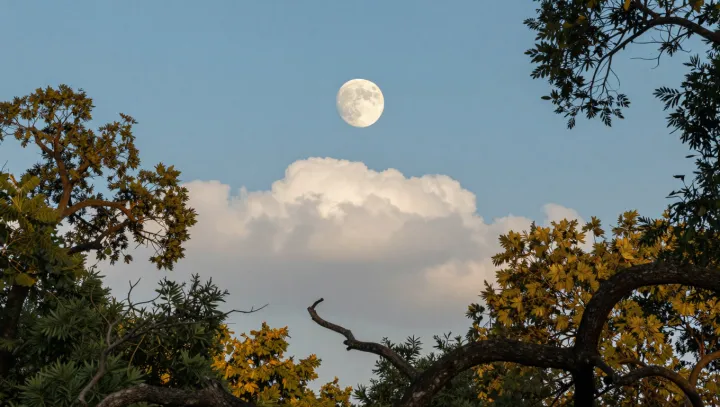
The Moon has no obligation to wait for darkness. Its sunlit surface can be bright enough to stand out against the blue sky, even when the Sun is above the horizon. The puzzle is not why the Moon sometimes appears by day, but why its shape changes the hours at which it can be seen.
A full Moon keeps almost opposite company from the Sun. At full phase, Earth lies roughly between the two, so the Moon generally rises near sunset and sets near sunrise. Daylight appearances are possible near the horizon, particularly around sunrise or sunset, but a full Moon high in a bright afternoon sky is another matter. Geometry rules it out. Atmospheric refraction and an observer's latitude can complicate the timing, without changing the basic arrangement.
A half Moon has a more convenient appointment with daylight. At first quarter, the Moon is roughly at a right angle to the Sun as viewed from Earth; it rises around midday and can stand high in the afternoon. Its phase reflects the angle between the Sun, Moon and Earth, not Earth's shadow falling across its surface. Rayleigh scattering makes the daytime sky bright by redirecting sunlight through the atmosphere, but the Moon can still offer enough contrast to be seen. The orbit moves it on. A pale disc remains suspended in blue, a piece of night that never belonged exclusively to it.