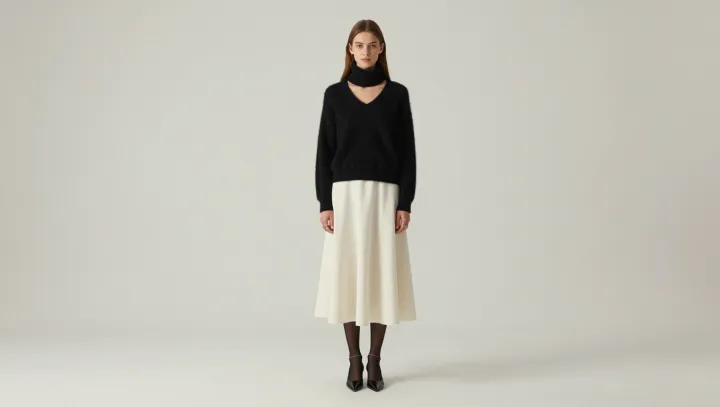
The white skirt does the heavy lifting, even though its color looks light. Against a fitted black knit, its flowing shape gives the lower half room to breathe, balancing the close line above with a broader sweep below. Size is not everything. The contrast between restraint and movement makes the outfit feel composed rather than divided.
Proportion matters more than color alone. The fitted knit defines the torso and creates a narrow starting point, while the midi skirt falls away from the waist, adding volume without hiding the connection between the two pieces. In fashion terms, the silhouette depends on that change in scale: a compact top sets off a fuller skirt. Fabric matters, too. A skirt that drapes and moves can carry a generous area of white without looking stiff, though a heavier fabric would produce a more structured effect.
The dark accessories keep the white from floating away. Tights create a visual link between the black knit and the pointed heels, drawing the eye through the pale expanse of the skirt and back to a dark finish. The points sharpen the outline. Here, balance is less a matter of distributing equal amounts of black and white than of giving each shape a clear role: the knit contains, the skirt opens, and the shoes bring the line to a close. Between those dark bookends, the lightest piece has space to move.