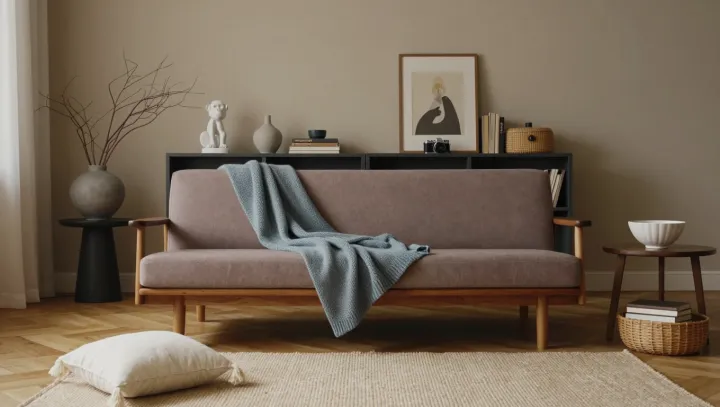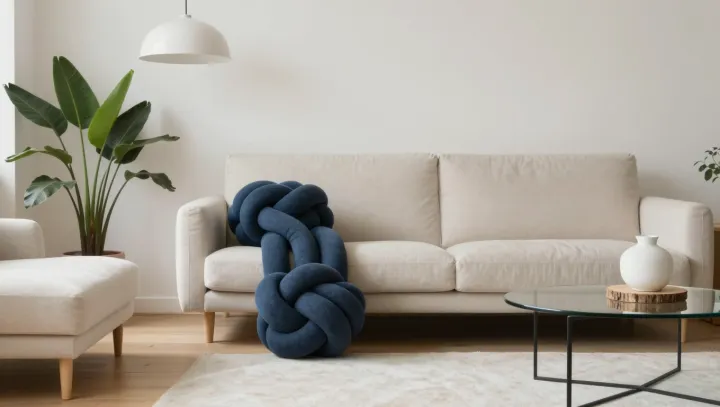
A knotted cushion can make a white sofa look more intricate without introducing a single pattern. The trick is physical. Its dark loops cross, recede and rise against the pale upholstery, giving the eye a succession of edges and shadows where a flat cushion would offer a single surface.
Form does the work that print might otherwise be asked to perform. As the fabric bends around itself, light meets each curve at a different angle, creating tonal shifts within the same material. The effect depends on contrast. Against a white sofa, the cushion's silhouette becomes especially legible, while the gaps between its loops let the lighter surface remain visible. Designers call that surrounding area negative space; here, it is part of the composition rather than a blank left over. Even the folds matter, because they soften the geometry and make the object feel as inviting as it looks.
Restraint, in this setting, is not the same as visual emptiness. A room can keep a narrow palette and still offer variety through scale, depth and the tactile character of its furnishings. Placement matters, too. A cushion set against an uninterrupted stretch of upholstery will read differently from one crowded by other accessories, whose shapes may compete with its outline. The appeal lies in that tension: a soft object holds its place on the sofa almost like a small sculpture, while remaining something to lean against. On the white seat, its loops draw shadows that are never quite still.