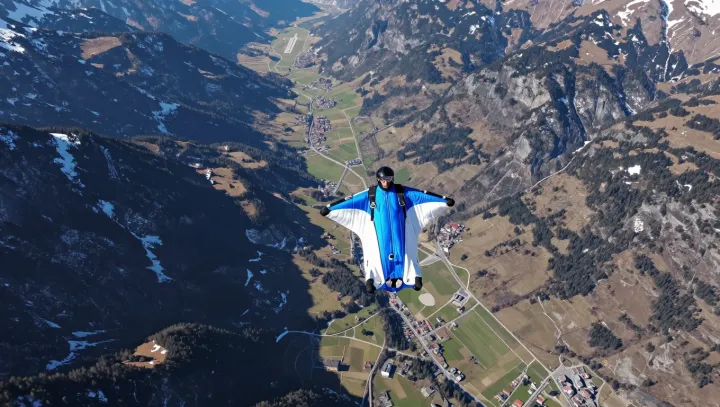
A wingsuit does not defeat gravity; it bargains with it. That bargain is visible above a mountain valley, where fabric stretched between the arms, torso and legs turns a fall into a glide. The flyer travels forward, sometimes with striking speed, while the ground continues to rise in the field of view.
The suit earns its range by redirecting air. As the flyer moves through it, the fabric wings produce lift, a force perpendicular to the oncoming airflow, along with drag, which acts against the motion. Because the flight path slopes downward, lift tilts partly forward: it can help balance drag as well as support some of the flyer's weight. More lift does not mean a free escape from descent. In a steady glide, gravity supplies the energy lost to drag, and the price is altitude.
The apparent contradiction is really a matter of energy. A flyer can briefly trade speed for height or reduce the rate of descent, but a fabric suit has no engine to replace energy dissipated into the air. Sustained level flight would require another energy source. The parachute changes the bargain: its much larger surface creates drag that slows descent enough for a landing, though deployment and landing remain hazardous. Above the valley, the wingsuit offers distance, not reprieve.