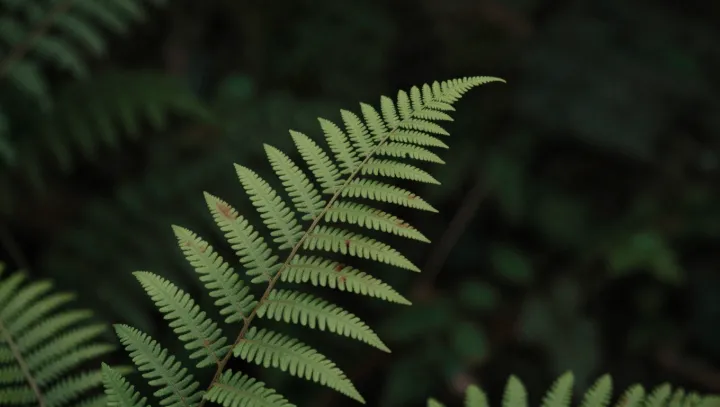
A fern's most consequential life is often its least conspicuous. Long before dinosaurs appeared, fern ancestors had already adopted a reproductive cycle that still hides in plain sight: the leafy plant releases spores, but those spores do not grow directly into another leafy fern. First comes something altogether different.
The spore's first act is one of reinvention. Given suitable moisture and light, it germinates into a gametophyte, often a small, heart-shaped sheet of green tissue that makes its own food through photosynthesis and anchors itself with threadlike rhizoids. It is an independent plant, not a baby frond. Its cells contain one set of chromosomes, unlike the two sets found in the familiar leafy fern. On its underside, reproductive structures can produce eggs and sperm.
Water is the cycle's exacting condition. Fern sperm have flagella and must swim through a film of water to reach an egg held inside a structure called an archegonium; without that liquid route, fertilization cannot occur. The resulting embryo has two sets of chromosomes and grows into a sporophyte, initially nourished by the gametophyte before developing roots and fronds of its own. The mature sporophyte produces spores by meiosis, starting the cycle again. For all the grandeur of a fern-covered forest, its continuity may turn on a thin film of water.