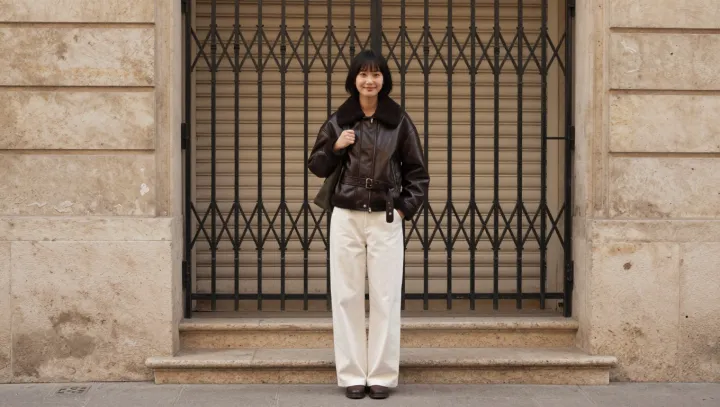
A cinched waist can make trousers look longer without adding an inch of fabric. The belt gives the eye a clear starting point, while the white legs carry that line toward the floor. It is a trick of proportion, not a change in the garments. The distinction matters.
The jacket does its best work when it stops competing with the trousers. Left loose, its hem can obscure the waist and make the upper body read as one broad shape; drawn in, the leather reveals where the torso narrows. The perceived waistline, especially if the belt sits near the natural waist, can make more of the white fabric register as leg. Visual hierarchy explains the effect: the belt establishes a focal point, and the pale expanse below becomes the dominant vertical shape. Nothing has physically stretched. The eye has simply been given a different set of cues.
Wide legs are an advantage, not an obstacle, provided the waist remains legible. Their generous cut falls in long, relatively uninterrupted columns, while the contrast between brown leather and white fabric separates top from bottom. Dark shoes and a dark bag can echo the jacket without interrupting the trousers, though shoes that strongly contrast with the hem may draw attention to where the legs end. Hem length and fit still count: fabric that pools heavily or bunches at the ankle can blur the line. A belt cannot rewrite a body, but it can redraw the frame through which it is seen.