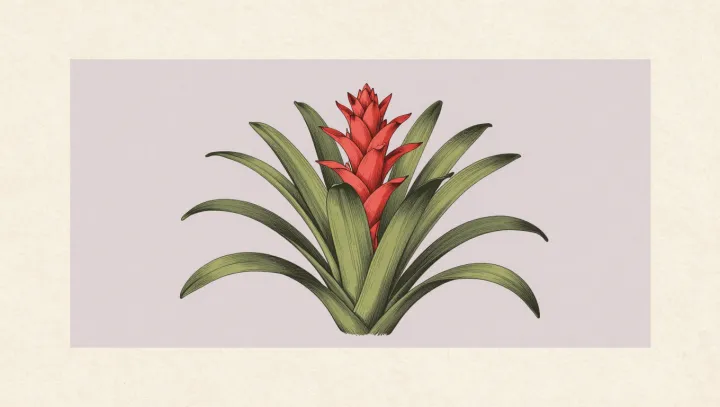
The parrot bromeliad's brightest display marks the beginning of its rosette's end. That is no accident. Once the plant commits its central growing point to a flower spike, that rosette cannot return to making leaves in the same way. Yet the plant's story is not confined to one rosette.
The apparent contradiction rests on a change of purpose at the plant's center. The apical meristem, a region of actively dividing cells, shifts from producing leaves to forming an inflorescence. This pattern is called monocarpic flowering: the individual rosette blooms once and then gradually declines. Its colorful display includes bracts, modified leaves that surround the flowers and may remain conspicuous after the flowers themselves fade. Pollinated flowers can produce seeds, allowing reproduction with genetic variation. The fading rosette is not necessarily finished at once, however; it can continue supporting growth elsewhere on the plant as it declines.
The more reliable continuation is often already growing at the base. These offsets, commonly called pups, arise from lateral buds and draw support from the parent rosette while developing leaves and roots of their own. They are clones. Unlike seedlings, they generally carry the same genetic material as their parent, and each can eventually produce its own flower spike. A gardener can leave the offsets clustered or separate them once they are substantial enough to grow independently. Thus the spectacle closes on one rosette while, close to the soil, another quietly takes its place.