A moon can be both a ring's architect and its raw material. Gravity does the work. In an imagined planetary system, the same forces that allow moons to carve gaps and sharpen ring edges can, under different conditions, pull a moon apart and leave its fragments circling the planet.
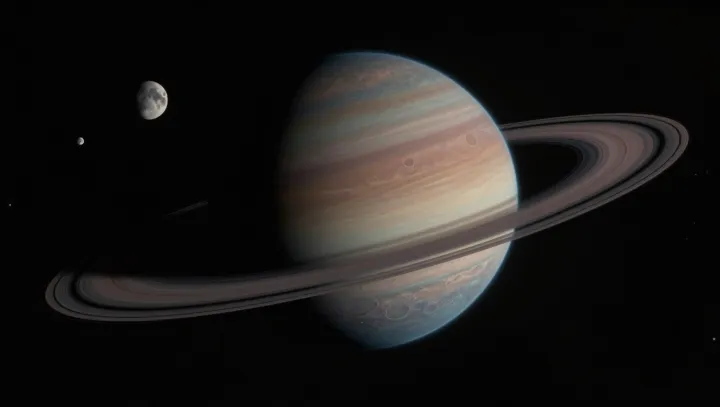
Ring patterns are less passive than they look. Small moons exert gravitational pulls on nearby particles, exchanging orbital energy and angular momentum with them; some act as shepherd moons, helping confine the edges of a ring. Repeated encounters matter most. At an orbital resonance, a particle and a moon complete their circuits in a regular numerical ratio, allowing repeated tugs to build up. Those tugs can clear gaps or produce waves, depending on where the particles orbit. The rings are not solid sheets: they consist of countless separate pieces moving around the planet.
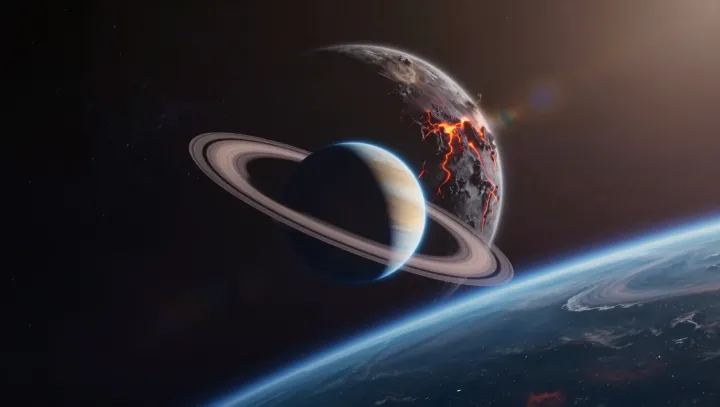
Destruction, too, has its conditions. Close to a planet, the difference in its gravitational pull across a moon can overwhelm the moon's self-gravity, especially if the body is loosely bound. The Roche limit describes the approximate distance inside which such a body may be disrupted; composition and internal strength affect whether it actually breaks apart. Fragments need not settle immediately. Collisions can redistribute their energy and spread debris into a disk, although some material may fall onto the planet or escape. The illustration offers no evidence that these events occurred in the system it depicts. Its moons and rings instead hold a possibility: the border between a companion and a cloud of debris can be drawn by gravity.