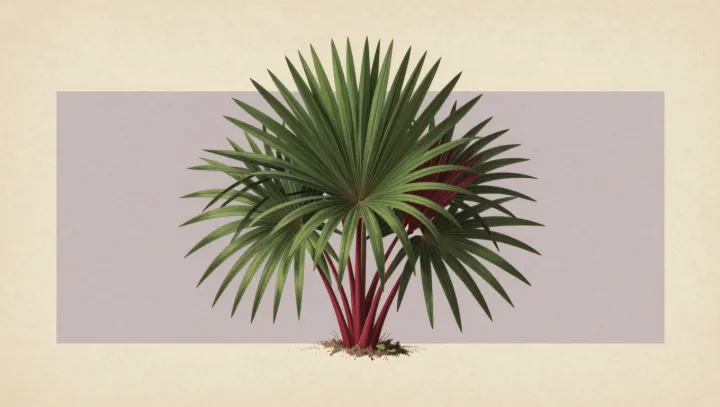
The calathea needs no muscles to lift its leaves. Water does the work. As light fades, many purple-backed calatheas raise their green blades, revealing reddish-purple undersides; as daylight returns, the leaves tend to spread again, a movement governed by living cells rather than any muscular machinery.
The secret lies at the hinge. At the base of a leaf stalk sits a flexible swelling called the pulvinus, where changes in turgor pressure make cells on opposing sides expand or relax. Charged particles move across cell membranes, and water follows by osmosis. When one side becomes firmer than the other, the joint bends, carrying the leaf with it. Reverse the pressure difference and the blade can return. It is a hydraulic movement, not a miniature imitation of an animal flexing an arm.
The schedule is more than a response to darkness. Leaf movement of this kind, called nyctinasty, is influenced by an internal circadian clock: a network of molecular processes that keeps roughly daily time. Light provides an outside cue that helps synchronize that clock with the environment, while also affecting leaf position directly. The rhythm can persist for a time under constant conditions, though its timing may drift without regular light cues. Scientists have proposed that these movements can affect light capture or exposure to nighttime conditions, but their precise benefits vary among plants and are not settled for every calathea. No single purpose is assured. At dusk, the raised leaves hold their color against the fading light.