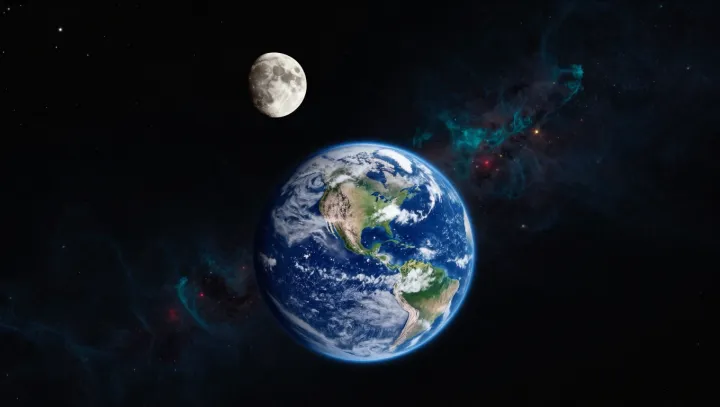
The Moon is leaving Earth, yet it keeps nearly the same face turned toward us. That apparent contradiction is the signature of a relationship written in gravity rather than stillness. The separation grows by roughly 3.8 centimeters a year, measured with laser pulses bounced off reflectors on the lunar surface. Nothing stands quite still.
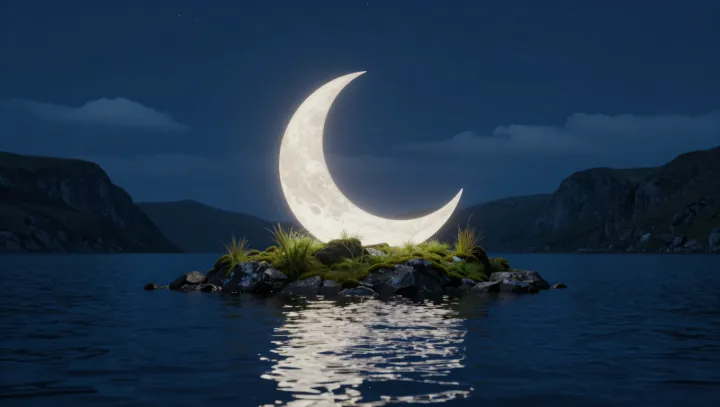
The familiar crescent is less a changing object than a changing view. The Moon shines by reflected sunlight, and its phases arise as its orbit exposes different portions of its sunlit half to observers on Earth. A full Moon appears when Earth lies approximately between the Sun and the Moon; a new Moon occurs when the Moon lies roughly between Earth and the Sun. Earth's shadow is not responsible for ordinary phases. That distinction matters. Only during a lunar eclipse does that shadow darken the Moon.
The steady lunar face conceals a history of friction. Tidal locking means the Moon rotates once on its axis in the same time it takes to orbit Earth, a state produced by gravitational forces that gradually slowed its early spin. Small shifts in viewing angle, called libration, let us glimpse slightly more than half its surface over time. Earth feels the pull too. The Moon's gravity helps raise ocean tides, and friction associated with those tides transfers angular momentum from Earth's rotation to the lunar orbit, pushing the Moon outward. The Sun also influences tides. In that pale, familiar face is a record of two worlds still reshaping each other.