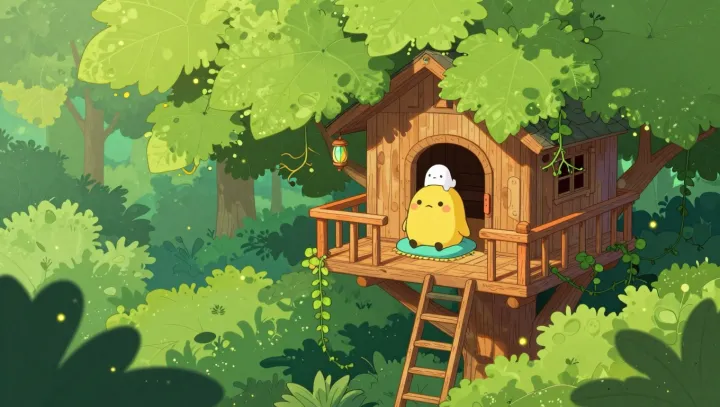
A secure treehouse must be allowed to move. Beneath enormous leaves, a tiny shelter houses a white ghost and a yellow companion, surrounded by vines and miniature furniture. The scene is fanciful, but its setting poses a real engineering problem: a living tree grows thicker and bends when the wind blows.
Rigid construction is a poor bargain with a moving tree. Wind produces dynamic loading, and branches or neighboring trunks can sway at different rates; a platform that restrains them may put excessive force on both its supports and the wood. Tree attachment bolts are designed to carry substantial loads, while sliding joints can allow a supported structure and its host to move relative to each other. The arrangement depends on the tree and the expected loads. No fitting works everywhere.
Growth demands respect, not a tight embrace. The cambium, a layer beneath the bark, produces new wood and contributes to an expanding trunk; hardware that encircles it can eventually constrict living tissue. Trees also respond to wounds by compartmentalizing damaged wood, but that response does not make an attachment harmless. An arborist and a qualified structural designer can assess tree health, loads and attachment options, with periodic inspections to catch decay or loosened components. In the miniature shelter, everything holds still; outside it, the tree keeps making room for itself.