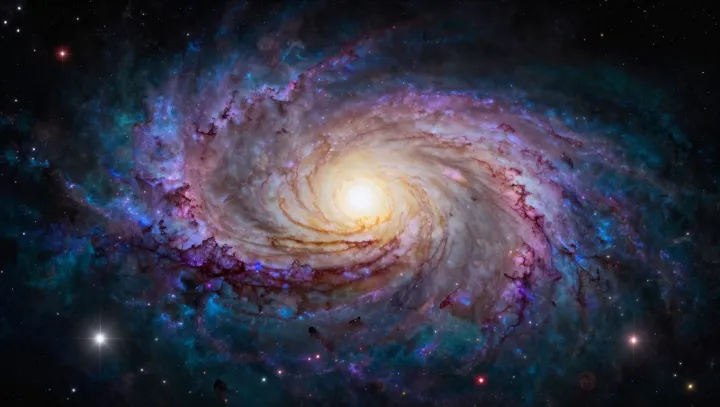
Spiral arms are not the fixed structures they appear to be. Stars nearer a galaxy's center generally complete their orbits faster than stars farther out, so an arm made of the same stars would wind ever tighter. Yet many galaxies retain broad, sweeping patterns. Something else must be at work.
The most elegant explanation treats an arm as a pattern through which material moves. In density wave theory, gravity helps maintain regions of greater density as stars and gas travel through them at different speeds. The stars do not march together. Gas entering an arm can be compressed, encouraging the formation of hot, luminous young stars that make the pattern stand out. These stars live relatively briefly, so their light often marks places where star formation has recently occurred. Dust, meanwhile, can trace the denser gas along an arm.
The neater picture is not necessarily the whole story. Computer simulations suggest that some spiral arms may be transient structures, forming and dispersing as stars and gas respond to gravity, rather than enduring as a single wave. Interactions with neighboring galaxies can also create or strengthen arms. Different galaxies may follow different scripts. The illustration's bright center and sweeping arms therefore capture a shape, not a record of which stars have stayed together. What looks permanent may be a succession of patterns, each written across a moving field of stars.