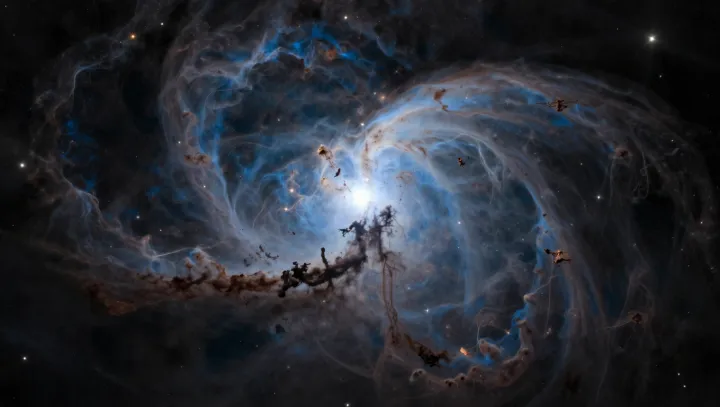
Orion is a trick of perspective. Its stars seem to belong together because their light reaches Earth from nearly the same directions, not because they sit side by side in space. The hunter's outline is a projection, flattened onto the sky like a drawing on a window.
The distances spoil the picture. Bellatrix, one of Orion's shoulder stars, lies roughly 250 light years from Earth; Rigel, marking a foot, is about 860 light years away. A light year measures distance, not time: it is the distance light travels in one year. Astronomers estimate stellar distances using methods including parallax, the apparent shift in a star's position against more distant objects as Earth moves around the Sun. For faraway stars, that shift is exceedingly small, and measurements can carry substantial uncertainty. Similar brightness offers little help in judging proximity, because stars differ greatly in their intrinsic luminosity. A powerful star far away can look brighter than a weaker one nearby.
The hunter is also coming apart. Stars travel through the galaxy at different speeds and in different directions, producing proper motion: a gradual change in their apparent positions across the sky. Orion's familiar outline will therefore change over immense stretches of time, although no casual observer will see it shift in a lifetime. Some of its stars are physically associated with the broader Orion region, but the constellation as a whole is not a single compact group. For now, the hunter holds his pose, a figure drawn by distance as much as by light.