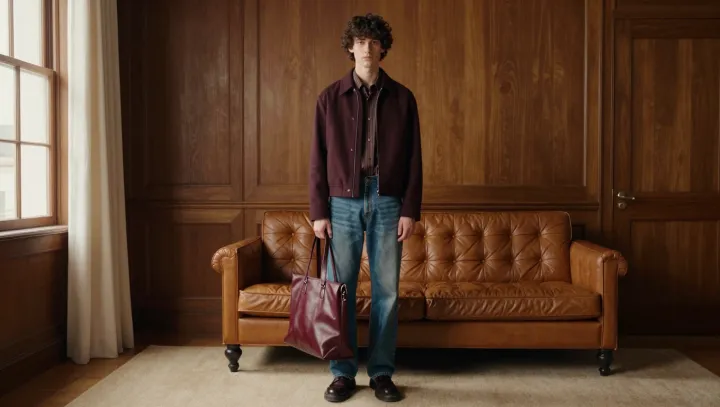
Repetition gives this outfit its authority. A burgundy jacket and an oversized bag in the same rich color frame wide-leg blue jeans, linking pieces that might otherwise compete for attention. The shapes do not match. That is precisely the point: color supplies the connection that cut and texture refuse to provide.
The jeans benefit from the contrast rather than disappearing into it. Wide legs create a generous silhouette, while the jacket and bag establish two distinct points of emphasis; the eye can travel between them without treating the denim as an accident. It is visual rhythm, not uniformity. In color theory, the deep red of burgundy sits against blue with enough distinction to make each visible, while their shared depth keeps the combination from feeling too sharp. The bag matters as much as the jacket: its scale gives the repeated color sufficient weight to register across the outfit.
Matching, here, is more persuasive when it stops short of sameness. The jacket belongs to the body; the bag extends beyond it, and the denim introduces a different texture and proportion. Those differences leave room for movement. A smaller accessory in the same shade might create a subtler echo, but the oversized bag makes the connection harder to miss. What emerges is not a formula for dressing so much as a useful distinction between coordination and conformity: one allows each piece its own character, while the other asks it to fall in line. Against the blue, the two burgundy forms hold their separate ground.