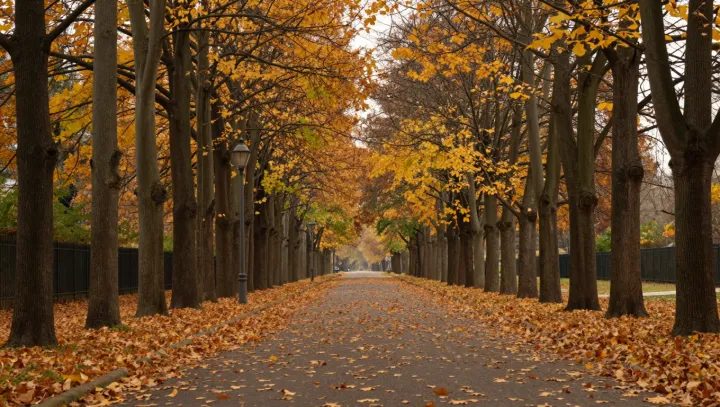
The gold beneath a tree is not a sudden invention; it has been in the leaves for much of their lives. Green simply had the louder voice. As daylight shortens and trees prepare for winter, chlorophyll breaks down, allowing pigments that were masked through the growing season to show.
This is less a costume change than a withdrawal. Chlorophyll absorbs light for photosynthesis, helping leaves make sugars, but it is continually broken down and replaced while leaves are active. During senescence, the process by which a leaf ages and shuts down, replacement slows and the green pigment disappears. Carotenoids, including yellow xanthophylls, remain visible longer. They have useful work beyond providing color: they help capture light and protect leaf tissue from damage caused by excess light.
The fallen road carries evidence of a careful economy. Before a leaf drops, a tree can recover some of its nitrogen and other nutrients for storage and later use, while a layer of cells at the leaf stem forms an abscission zone that eventually allows the leaf to detach. Species and weather shape the display: pigment mixtures differ, and rain or wind can strip branches before colors linger. Not every leaf turns gold; some become red, brown or a mixture as their chemistry changes. On the ground, the bright fragments mark not waste alone, but the visible edge of a tree's retreat.