Spiral arms are not fixed streams of stars. That distinction matters. If the stars in an arm remained together as the galaxy rotated, differential rotation would pull the structure into an increasingly tight coil, because material nearer the center generally completes an orbit faster than material farther out.
The prettier explanation is also the less obvious one: an arm can be a pattern through which material moves. In density wave theory, regions of enhanced density travel around the disk at a speed that differs from the orbital speeds of many stars and gas clouds. Stars enter and leave. Gas can be compressed as it encounters an arm, encouraging the formation of massive young stars whose light makes the pattern stand out. Those stars burn brightly but do not live long, so their presence helps mark regions of recent star formation rather than a permanent collection of companions.
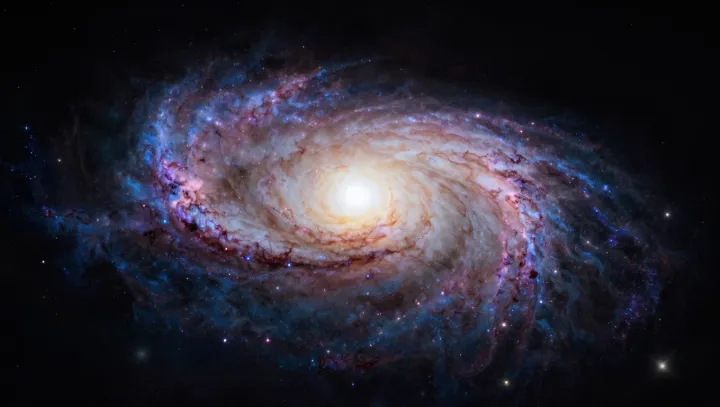
No single mechanism, however, has won custody of every spiral. Simulations and observations suggest that some arms are transient structures, shaped by gravity, interactions with neighboring galaxies, or instabilities within the disk; they can fade and form again rather than persist as one enduring wave. The central bulge and sweeping arms in an illustration capture the arrangement, but not its restless traffic. What looks like a figure drawn in light may instead be a shape continually made and unmade.