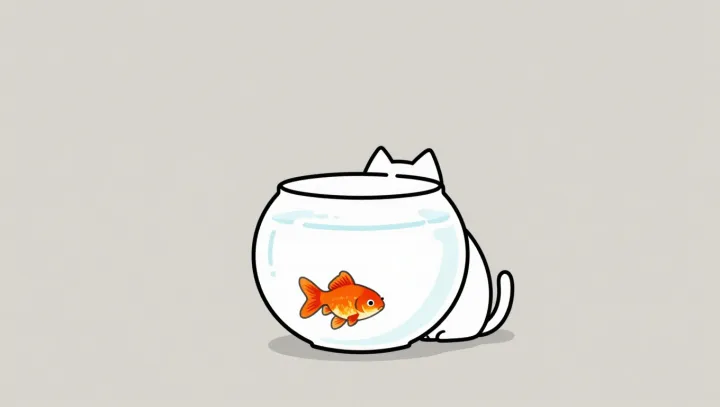
The cat behind the fishbowl is missing a sense that humans take for granted: sweetness. That absence is no quirk of manners. It is written into the animal's genes, a trace of an evolutionary history in which animal prey, not ripe fruit, supplied the rewards that mattered.
The defect is molecular, not a matter of taste preference. In many mammals, a sweet taste receptor forms from two proteins, produced by the genes TAS1R2 and TAS1R3. Cats have a nonfunctional TAS1R2 gene, so they cannot assemble the receptor in its usual working form. Sugar can still enter a cat's mouth; the familiar sweet signal does not follow. A cat drawn to ice cream may be responding to its fat or texture rather than its sugar.
This loss fits the demands of an obligate carnivore, though it does not by itself explain how cats became meat specialists. Their diet supplies nutrients that they cannot make in sufficient quantities on their own, including taurine, and their ancestors faced less pressure to retain a receptor useful for detecting sugars in plants. Mutations could accumulate as natural selection relaxed its hold on that function. The evidence is a record of adaptation, not a claim that evolution deliberately removed an unwanted feature. Behind the glass, the cat sees a fish; the sweetness it cannot taste leaves no reflection.