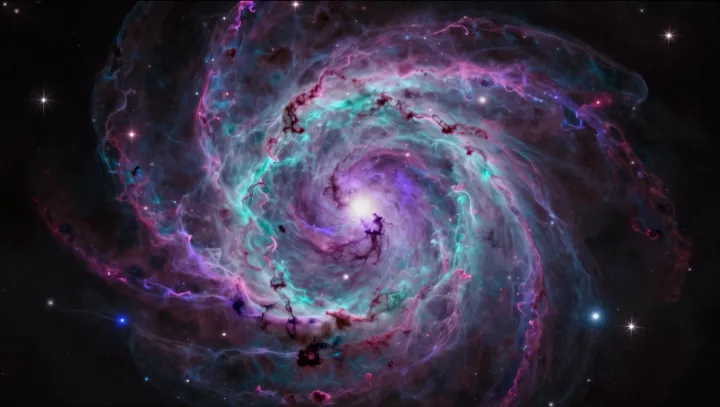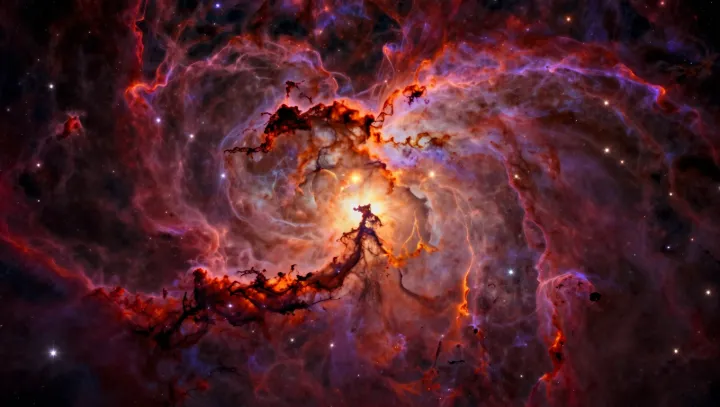
Emptiness, not light, carries the most disruptive news from the Milky Way this time. A perfectly carved bubble, more than ten billion kilometers across, sits inside a dense band of gas, its edges glowing while its interior is almost entirely stripped of detectable matter.
The claim is stark: one dying star did this. Astrophysicists point to a supernova whose blast wave, a high‑velocity shock front, expanded through the interstellar medium and evacuated the region, compressing neutral hydrogen and molecular clouds into a thin shell where emissions spike in radio and X‑ray surveys. The cavity’s symmetry, its pressure balance, and the velocity gradients of gas at its boundary match classic Sedov–Taylor solutions for an explosive event in a roughly uniform medium, rather than a slow, many‑source erosion.
The larger argument is bolder: such voids are not anomalies but the main sculptors of galactic texture. Each supernova injects energy and momentum, a process known as stellar feedback, that punches holes, drives turbulence, and can both quench and trigger star formation by alternately dispersing gas and squeezing it into dense, gravitationally unstable filaments. Where the bubble is empty, nearby filaments thicken; where the shell cools, new protostars ignite. Galaxies, this bubble suggests, are not smooth disks of gas and stars but porous structures, constantly re‑etched by the violence of their own brightest members.