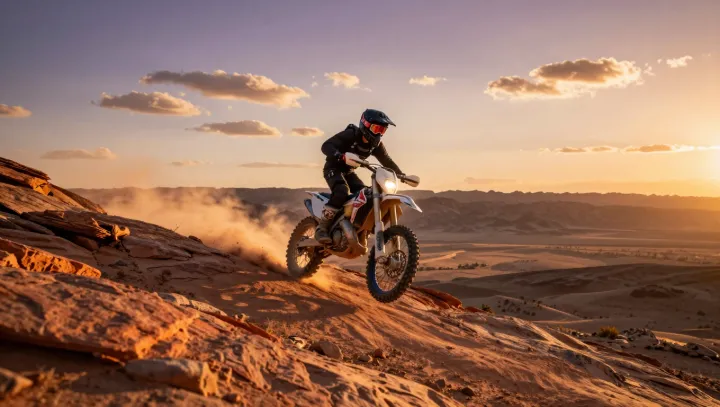
Low-angle light turns the desert into a blunt instrument of truth. Under sunset glare, sand and rock stop hiding, and expert riders treat that color shift as advance telemetry, not scenery.
They trust hue before feel. When the sun skims the horizon, its shallow incidence angle exaggerates spectral reflectance differences between silica sand, embedded clay, and scattered gravel, so a faint move from warm orange to dull gray often marks a band of loose marble-like pebbles that will shear under load instead of supporting a tire carcass. Peripheral vision, tuned by thousands of micro-corrections, locks onto those bands as fast as the fovea locks onto the next turn marker, creating what sports scientists describe as a predictive control loop rather than a reactive one.
The real skill sits in how quickly the brain runs that loop. Seasoned desert specialists build an internal model of terrain friction, using optic flow and luminance gradients as inputs in much the same way a traction control algorithm uses wheel-speed differentials and throttle position. A slightly darker ribbon across a dune face may signal compacted, higher-cohesion sand that can carry a harder drive; a paler, almost chalky patch hints at powder that will swallow the front wheel. Bars twitch a hair earlier. Weight shifts a fraction sooner. By the time rubber arrives, the decision was already made in the rider’s visual cortex.