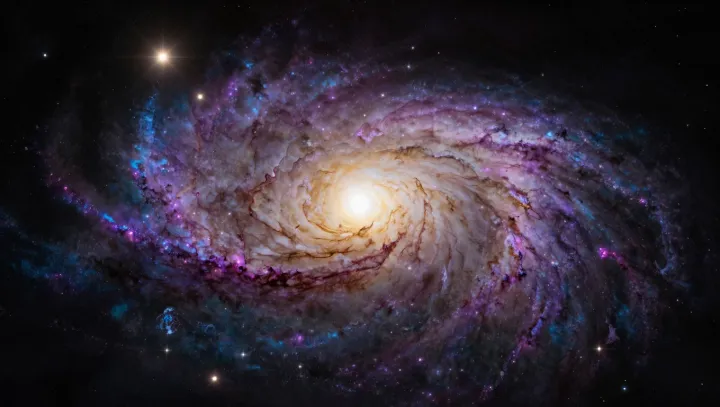
Empty space is not empty at all; that is the unsettling claim at the heart of modern physics. Between galaxies stretches vast near‑nothingness, yet quantum field theory insists every point in that void hosts jittering fields that never quite rest, producing fleeting particle–antiparticle pairs and a background vacuum energy that refuses to vanish.
More provocative is the idea that this ghostly energy is not just microscopic noise but a driver of cosmic architecture. In quantum electrodynamics, these vacuum fluctuations shift atomic energy levels in the Lamb shift and exert measurable Casimir forces between metal plates, proof that the vacuum is an active participant in ordinary laboratory physics rather than an inert backdrop waiting to be filled.
On the largest scales, that same concept mutates into the cosmological constant, a parameter in general relativity that acts like uniform negative pressure and accelerates cosmic expansion. Observations of distant supernovae and the cosmic microwave background point to a dominant dark energy component, often modeled as vacuum energy, yet naive quantum calculations overshoot its measured density by absurd factors, leaving theory and observation in sharp tension over how something so insubstantial could help decide whether the universe thins into cold isolation or evolves along some less desolate script.