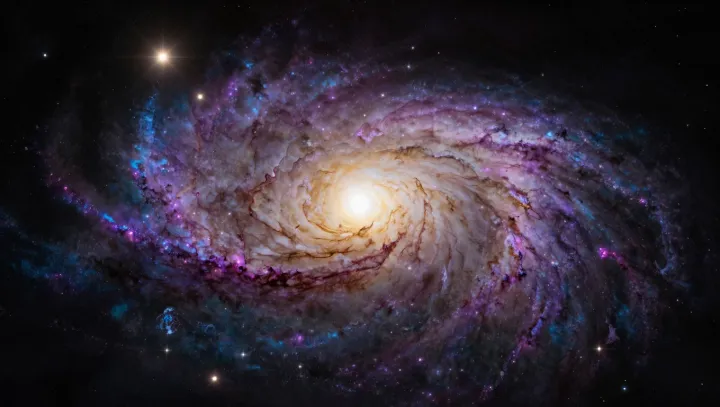
Emptiness, not abundance, is the defining feature of a bright galaxy. Between its hundreds of billions of suns, the typical separation is measured in light‑years, while the average particle density in the interstellar medium is roughly one atom per cubic centimeter, far below any laboratory vacuum. Stars, nebulae, and dust sit as thin punctuation marks inside volumes that are almost entirely void by everyday standards.
Even that feels crowded once you step outside the galactic disk. The surrounding halo and the wider intergalactic medium drop to about one atom per cubic meter, a density set by the cosmic mean and stretched further by metric expansion described by the Friedmann equations. Gravity, guided by dark matter, amplifies tiny primordial fluctuations into filaments and clusters, leaving vast cosmic voids where matter simply never collected. A galaxy looks full only because its rare bits of baryonic matter have collapsed into luminous knots, while most of its mass hides as diffuse dark matter and most of its volume, and the space beyond, remains almost perfectly empty.
Emptier still is the conceptual picture that emerges from this: a universe in which structure is the exception, vacuum the rule.