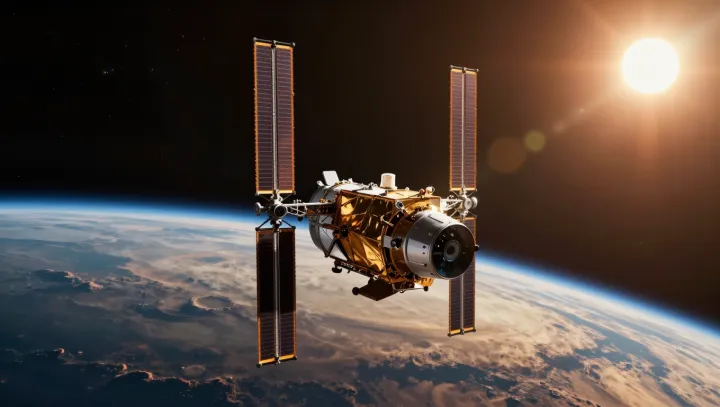
Thin sunlight should be a deal‑breaker for planetary cartography at Mars, yet it is the main enabler. At roughly half the solar flux seen near Earth, orbiters compensate not by brute force propulsion, but by turning every photon into disciplined electrical work through oversized solar arrays and ruthlessly efficient avionics.
The real trick is that mapping does not demand continuous high power; it demands consistent geometry. A near‑polar, sun‑synchronous orbit, set by orbital mechanics rather than muscle, lets the spacecraft pass over each longitude under repeatable lighting, while charge‑control electronics sip current into batteries during daylight arcs and release it in shadow. Short. Instruments such as high‑resolution cameras and thermal infrared radiometers are pulsed on only when they cross targeted ground tracks, and their detectors use low‑noise CMOS or CCD architectures to cut power per pixel.
Energy gets stretched even further by data discipline. Short. Solid‑state recorders buffer raw images, then onboard compression hardware strips redundancy before a narrow‑beam antenna locks onto Earth for downlink during limited communication windows. Large deployable panels trade mass for surface area, building a power moat around operations so the mapping campaign can run for many orbits without brownouts, turning faint sunlight into a slow but steady planet‑wide survey engine.