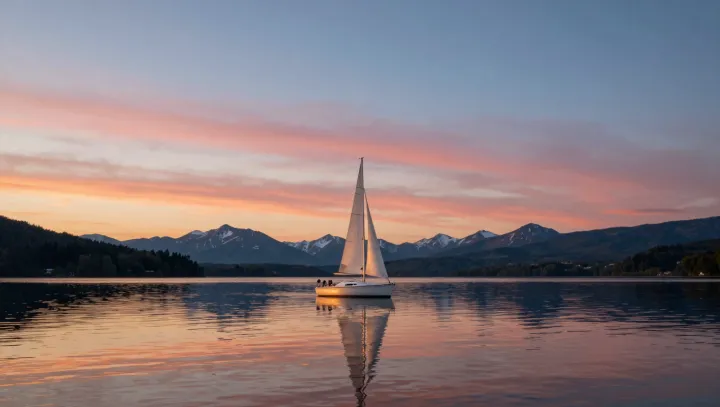
Glassy water is not calm. On a lake at sunset, a flawless mirror often signals that the air–water system has slipped into a delicate, unstable balance, one in which minor shifts in temperature or pressure can flip the wind field faster than any visible ripple can warn.
Seasoned crews trust physics, not pretty views. As surface winds decouple from higher air, strong flow can persist aloft while the boundary layer near the lake collapses, a classic case of vertical wind shear. Boats sit stalled under bare masts, yet a few mast-heights up, momentum still races past, ready to punch down through a microburst or a sudden gravity wave once the cooling pattern breaks.
Beneath that mirror, the story is no kinder. Density stratification builds as warm surface water caps cooler layers, storing potential energy in sharp thermal gradients. A shift in inflow from a river, or a distant squall line that never touches the shore, can reorganize subsurface currents and set up shear zones that twist a hull off course while the surface stays deceptively smooth.
The real hazard is latency. By the time catspaws appear, the pressure gradient has already moved, and a boat with full canvas up can go from motionless to hard heel in seconds. Veterans stay alert because they have learned that on a glassy lake, the only honest signals come from the barometer, the sky’s high clouds and the feel of changing temperature on the skin.