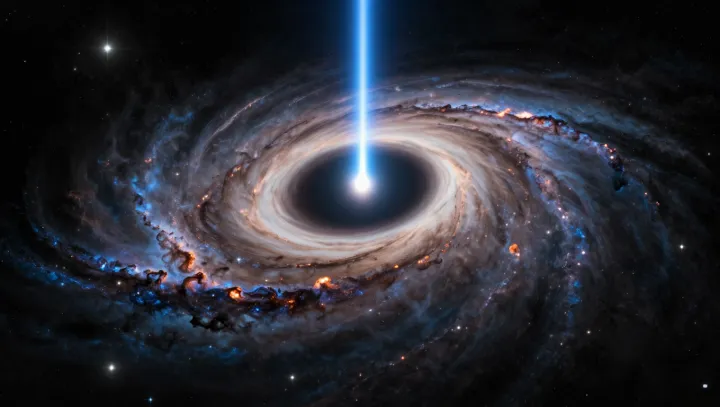
At the center sits the paradox, not the stars. A black hole that swallows light becomes, in practice, the brightest engine in a galaxy because the glow comes from everything still fighting to avoid the final plunge, not from the silent interior beyond the event horizon.
The key is brutality, not magic. Gas spirals inward in an accretion disk, where friction and magnetohydrodynamic turbulence shear particles into tighter orbits, converting gravitational potential energy into heat and high energy radiation with an efficiency that can beat nuclear fusion by an order of magnitude. Some matter skims just outside the innermost stable circular orbit, heats to extreme temperatures, and radiates across the spectrum before any fraction actually crosses the horizon and disappears from view.
Even stranger are the jets. Near the spinning black hole, twisted magnetic field lines anchored in the disk tap the rotational energy of the hole itself through the Blandford–Znajek process, collimating plasma into narrow beams moving at relativistic speed. Those jets punch out of the galaxy, compressing gas, lighting up radio lobes, and channeling a large share of the liberated energy into space while the central object remains perfectly dark.