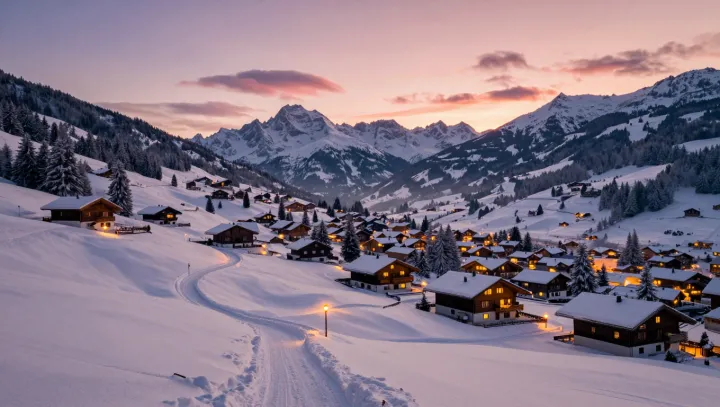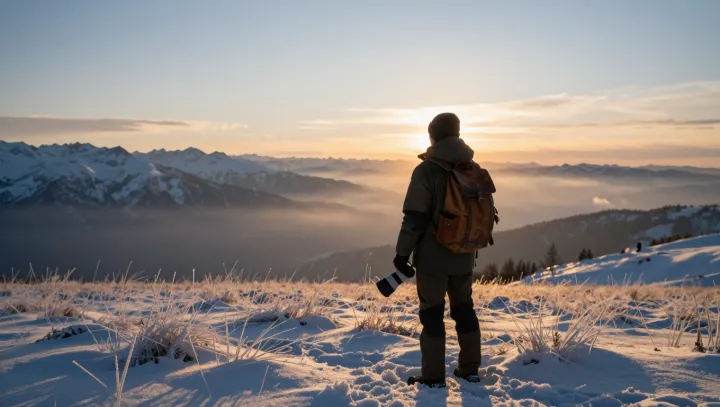
Calm is a trick. A frame loaded with peaks, drifting mist, fresh snow and a tiny human should feel noisy, yet the eye settles almost instantly when low-angle light and depth cues line up in its favor.
Light, not subject matter, calls the shots here. When illumination rakes in from a low angle, it exaggerates luminance contrast along ridges, giving the visual cortex clean input for edge detection and figure–ground segregation, two workhorse routines inside the ventral visual stream that decide what is object and what is background before conscious thought even shows up.
Distance then behaves like an invisible editor. As air thickens with moisture, atmospheric perspective kicks in: farther ranges lose high spatial frequency detail and drift toward desaturated, higher-value tones, while nearer slopes stay darker and sharper. That gradient in contrast and color temperature quietly encodes a depth map, so neurons tuned to binocular disparity and motion parallax can assign a stable order to planes instead of letting mountains, fog and snow compete on the same layer.
The lone figure is almost an afterthought, yet it matters. Against a bright snowfield, a small dark silhouette becomes a high-salience target for foveal vision, giving the scene a single anchor point that tamps down visual search. What looks like serenity is really efficient neural processing: edges clarified, layers ranked, attention parked.