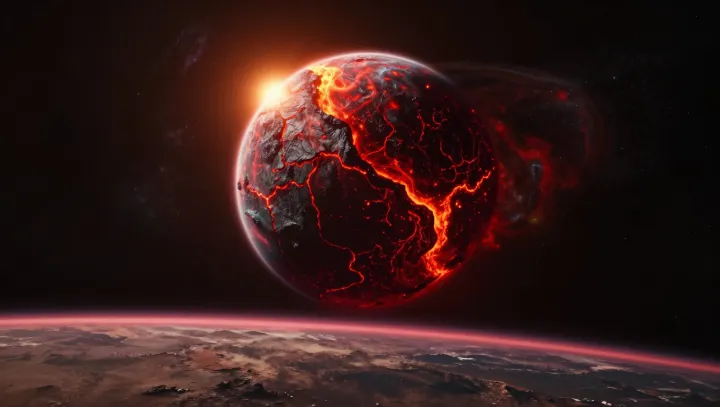
Glowing fractures on a rocky world are not a death sentence for the planet itself. They are evidence that its outer shell fails long before its deep interior even comes close to disruption. Under extreme tidal forces, stress concentrates in the brittle lithosphere while the bulk of the planet behaves as a slower, ductile solid that can flex without shattering.
The harsh truth is that rock is far stronger, per unit mass, than the self-gravity of most small and medium planets. Tidal stress from an eccentric orbit or a close giant companion can exceed the fracture strength of the crust, triggering magma ascent and tidal heating, yet still remain far below the threshold needed to overcome gravitational binding energy. As long as the body orbits outside the Roche limit, global breakup is dynamically disfavored and the planet stays intact.
What looks like a planet tearing apart is really a safety valve on repeat. Once the crust cracks, partial melt and convective mantle flow redistribute stress, so energy is vented as volcanism and infrared glow instead of wholesale fission. Differential stress is localized into rifts and lava lakes, not into a clean structural failure plane through the core. A tortured surface, yes. A destroyed planet, no.