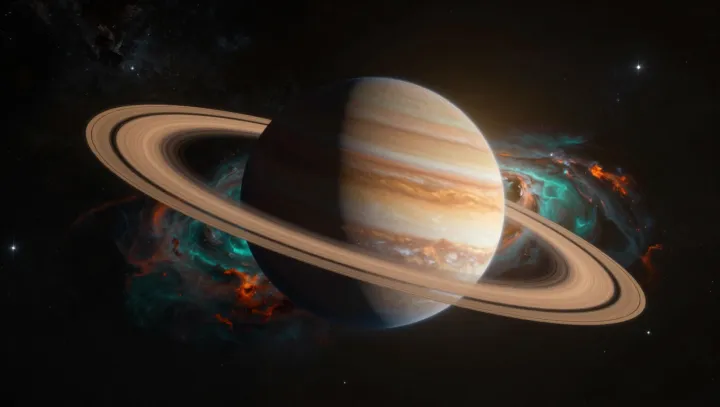
A thin line cuts across the black of space, and it lies. What looks like a blade around Saturn is in fact a broad disk of ice and rock, spread across hundreds of thousands of kilometers, shrunk by nothing more exotic than geometry.
The key is angle, not mystery. Planetary rings form a flattened disk in a defined ring plane, while observers on Earth see only the component of that disk projected onto the sky. When that ring plane is nearly edge-on to the line of sight, the projected width collapses into a narrow strip, even though the radial extent, set by orbital dynamics and Roche limit physics, remains enormous in physical space.
The effect is brutal in its simplicity. Ring particles occupy a region that is vast in radius but minuscule in vertical thickness, sometimes only tens of meters to a few kilometers across the whole structure. Because the vertical dimension is so small, the ring has negligible apparent height when viewed edge-on, and standard perspective projection maps that slender thickness into a near-zero angular size for distant telescopes, while the huge circumference still traces a visible arc.
Paradox is only in the eye. Shift the observing angle away from the ring plane and the full disk appears, bright and wide, revealing that what once seemed a single line is a geometrically thin, radially immense structure shaped by Keplerian orbits and gravitational shear.