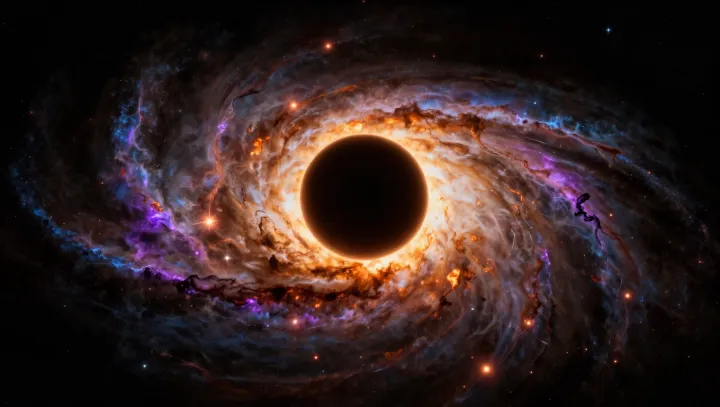
Darkness, here, is outrageously bright. Around a supermassive black hole, infalling gas does not slip quietly into oblivion; it slams into itself in a compact, spinning accretion disk where gravity converts gravitational potential energy into heat and high‑energy radiation with ruthless efficiency.
The counterintuitive part is simple. Stars burn nuclear fuel and waste most mass as gentle light, but gas spiraling inward can radiate a large fraction of its rest mass energy through viscous heating, bremsstrahlung, and synchrotron emission before it is swallowed. Magnetic fields tangle in the plasma, drive turbulence described by magnetorotational instability, and channel some of that energy into narrow relativistic jets that punch out along the rotation axis.
Brief excess is the whole trick. As matter crowds the inner disk near the event horizon, its temperature and luminosity spike, so the compact region can exceed the output of a galaxy spread over vast distances. Once the gas crosses the horizon, the light show stops, leaving only a fading echo from the jets and the hot disk it just consumed.