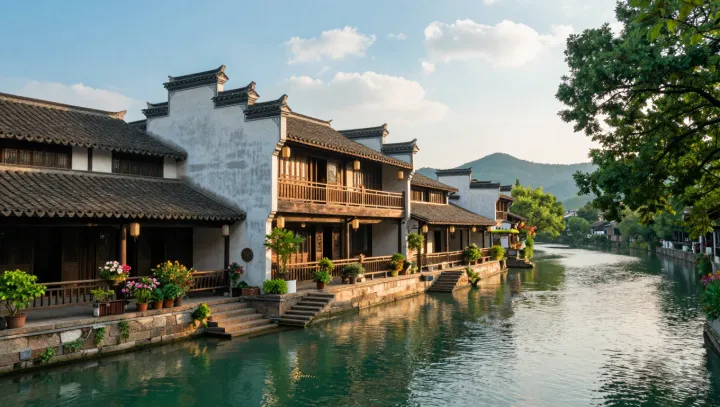
A narrow band of bright roofs can beat many chillers. Along a river edge, a row of low-tech houses, angled and shaded with almost obsessive care, can cut local air temperature and surface heat far beyond what their modest footprint suggests.
The blunt truth is that geometry cools faster than machinery here. High-albedo roofing bounces a large share of incoming solar radiation back to the sky, while steep angles reduce midday absorption and channel breezes down toward the water, enhancing convective heat transfer and boundary-layer mixing in ways most rooftop units never touch.
Shade does the quiet heavy lifting. Deep overhangs and arcades block direct shortwave radiation from facades and pavements, shrinking the mean radiant temperature that actually dictates how hot a body feels, even when the thermometer reads the same. Small shaded courtyards then act as low-energy reservoirs, storing cooler air that seeps toward the riverside path.
Trees, not turbines, close the cooling loop. Dense riparian planting drives evapotranspiration, turning sensible heat into latent heat with no compressor and no grid demand, while root systems stabilize moist soil that buffers diurnal temperature swings. The effect scales: extend that bright, shaded, tree-lined strip along the embankment and you get a continuous microclimate corridor that many mechanical systems, boxed on isolated roofs, never manage to create.