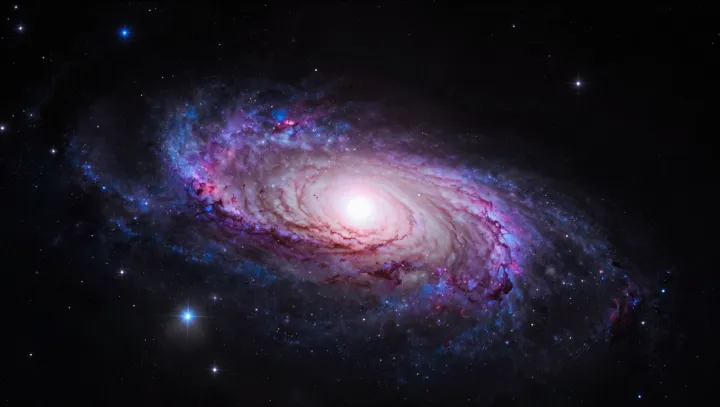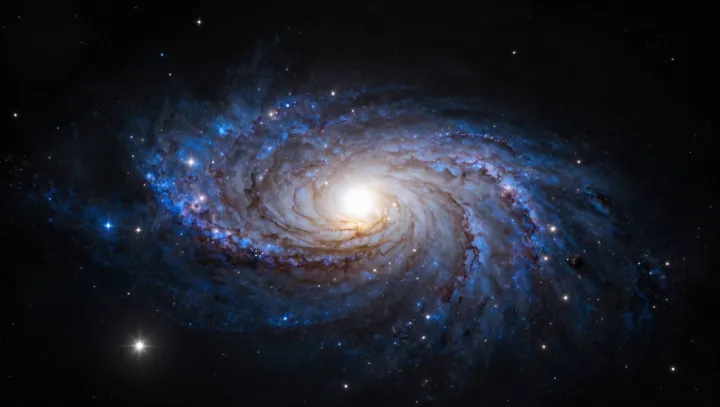
That radiant spiral is lying about its weight. Its glowing arms flaunt billions of stars, but the way the galaxy spins says those stars are only a small down payment on its true mass. Astronomers map the orbital speeds of gas and stars and build what they call a rotation curve, a profile of circular velocity as a function of distance from the center.
Here is the unsettling part. The visible light thins out toward the rim, yet the outer material orbits just as fast as the inner regions, a pattern that flat rotation curves stubbornly repeat. According to Newtonian gravitation and the virial theorem, that high speed at large radius demands much more gravitational mass than starlight can account for, even after adding cold gas and dust into the budget.
The honest interpretation is harsh on intuition. The bright disk is only a tracer; the real weight sits in a sprawling dark matter halo, an invisible spheroid of nonluminous particles that couple strongly to gravity but not to electromagnetic radiation. Photons shout, but the gravity field listens to mass, and the mass budget says the unseen component outweighs the shining stars by several factors. The more perfectly that spiral glows, the more stark the contrast with the silent, dominant halo that holds it together.