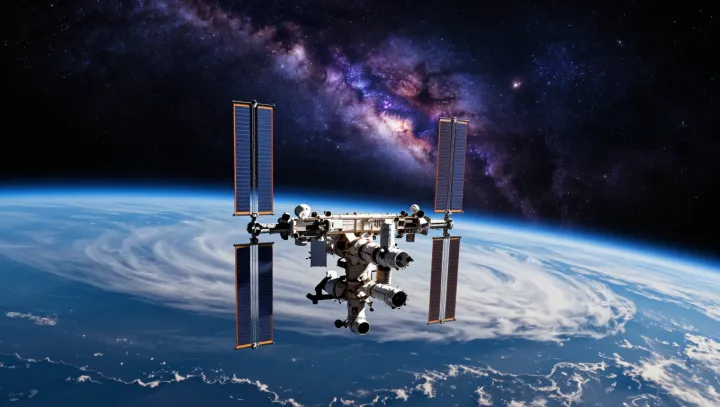
Metal panels glow, not from romance but from heat that has nowhere to go. A station in orbit is already dying the moment its pumps, gyros and solar arrays stop. No air. No convection. Just machinery hanging over a planet, every system exposed.
The blunt truth is that a station does not float, it falls in a controlled way. Atmospheric drag, though thin, keeps biting, so thrusters must fire to perform orbit maintenance, using propellant and guidance from precise orbital mechanics models. Miss a few burns and altitude decays. Miss enough and the structure reenters. That is not freedom. That is a deadline written in physics.
Even when its path holds, the station behaves like a factory that never shuts down. Power demand never sleeps. Solar arrays must track the Sun, feeding batteries through power conditioning units. During every eclipse the station runs purely on stored charge, so energy storage and energy management become life‑support for metal. Thermal control adds another constraint. Without air, radiators must dump heat by radiation alone, using ammonia loops and heat exchangers to keep electronics inside a narrow temperature band.
The harsher point is that the station’s own mass fights it. Every rotating module resists attitude control. Control moment gyroscopes, reaction wheels and magnetorquers constantly adjust attitude to keep antennas, docking ports and arrays aligned. Each correction draws more power, which generates more heat, which demands more cooling, which again calls for power. The loop never closes on its own; it must be forced shut by continuous human and software oversight, or the factory in vacuum grinds to a halt mid‑orbit.