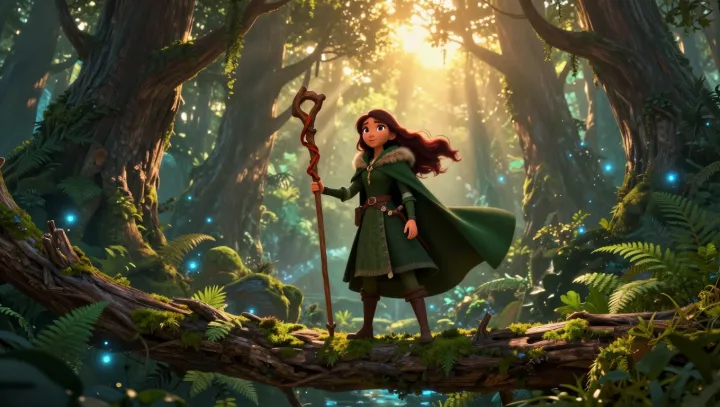
Blue owns the shade. Where a sunbeam strikes leaves, direct light is warm with yellow and red, but beneath the canopy the forest floor receives a poorer inheritance: skylight, filtered by air and leaf tissue, plus weak reflections that have lost much of their longer-wavelength company. The effect feels backward. Sun appears to create gold, yet, when its direct beam is withheld and the remaining illumination is judged against that brightness, blue can appear.
The trick is subtraction. Rayleigh scattering leaves the open sky disproportionately rich in short wavelengths, and a canopy blocks the direct solar component that would otherwise dilute this cast; multiple scattering among leaves, trunks, and ground keeps revising the spectral composition of light that reaches the understory. There is no emission. A shadow is not making blue photons, nor is some hidden surface glowing; it receives a shifted mixture, often far dimmer than the sunlit patch beside it.
The eye finishes the fraud. Chromatic adaptation treats broad, warm illumination as a reference, while simultaneous contrast pushes an adjacent low-luminance area toward a cooler complementary impression; as light falls, the Purkinje shift gives blue-green signals a stronger claim than red ones. Darkness supplies the drama. A camera's automatic white balance may mute or exaggerate the cast, but under the trees blue becomes less a pigment of night than a verdict rendered by air, leaves, and a judging retina.