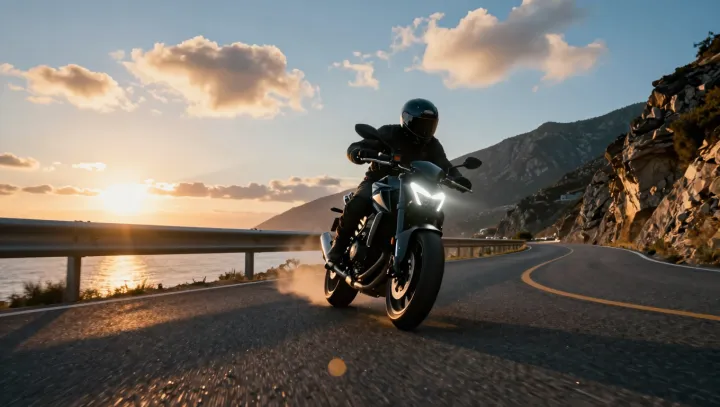
Sunset is a poor negotiating partner. On a coastal bend, the road can lose contrast just as a rider asks the tires to brake, turn, and carry load. Speed is not the issue. A finite friction budget is being spent while a low sun hides the line where dry pavement may yield to sand, salt, or damp.
The danger is arithmetic, not drama. Vehicle dynamics calls the limit the friction circle: longitudinal braking force and lateral cornering force draw from the same tire-road coefficient of friction. Think of it as a processor with finite cycles. When braking consumes capacity, less remains for lean; when lean rises, the reserve for braking contracts, while weight transfer can alter each contact patch's available grip.
Visibility makes that arithmetic meaner. Falling luminance slows hazard recognition, while glare can flatten texture and conceal contamination near the road edge. The eyes are running a bad sensor feed. Pupil adaptation and contrast sensitivity do not fail on command, yet they can lag rapid shifts between open sky, shadow, and reflected water. The technical prize is smarter control that fuses surface sensing, brake modulation, and light-aware warnings before the tire margin reaches zero.