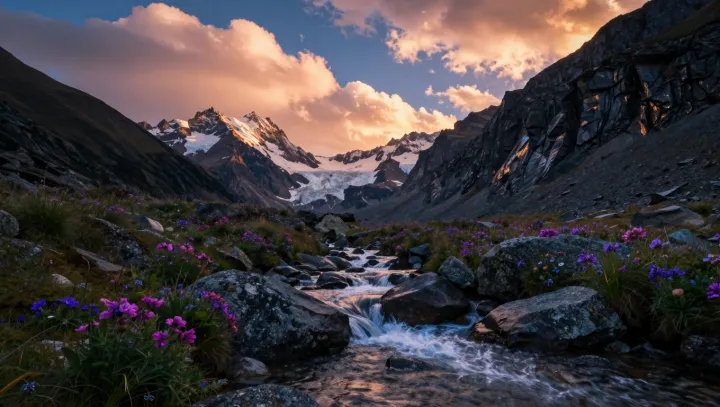
Snow retreats slowly. At its ragged edge, meltwater from a thawing snowpack enters gravel and alpine soil, while flowers wait through cold nights beneath hard sun. The contrast deceives. Ice beside petals is a timed transfer: winter precipitation is stored at altitude, then released in measured portions through the summer growing season.
That release is the mountain's quiet advantage. As meltwater infiltrates porous ground, it replenishes soil moisture around roots and prolongs streamflow after rainfall has vanished; capillary action can draw part of that water upward, where seedlings need it. Timing rules. Snow cover delays warming and emergence, shaping plant phenology so leaves and flowers appear during the narrow interval in which liquid water, nutrients, and sunlight coincide. Meltwater also mobilizes nutrients held in soil while warming permits microbial mineralization. In this system, late melting is not a nuisance. It is the calendar.
The display is less fragile than it looks. Its limits, however, are severe: if melt arrives too quickly, peak runoff may pass before flowering, and if snow cover is thin, exposed buds and soils face repeated freeze-thaw stress. Species rooted in shallow ground have little reserve once channels shrink. There is no magic here. Snowfields and wildflowers are joined by hydrology, not sentiment; as one dwindles, the other receives a fleeting allowance, then races against the return of cold.