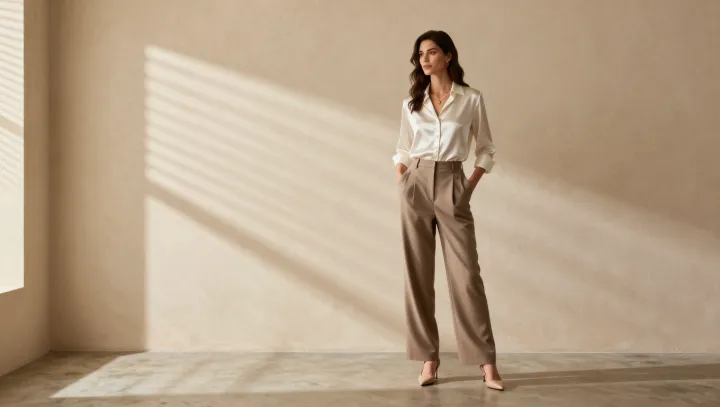
The tucked hem is a quiet optical trick, not a bodily event: by exposing or marking the waist, it shifts the eye's first estimate of where the lower half begins, even though bone length, muscle mass, and body composition remain untouched. No limb grows.
That distinction matters more than fashion advice admits. Bodies stay put. In visual perception, figure-ground segmentation makes a boundary more legible when a shirt meets trousers at the waist; occlusion then hides part of the torso, so the visible lower section claims more of the frame. It is relative. Color contrast can sharpen that boundary, while a continuous tone can blur it; neither choice alters the skeleton, but each directs attention toward a different coordinate.
The stronger reading is almost sly: styling borrows authority from measurement, though it changes only the measurement the eye improvises. Proportion becomes product. A higher visible waistline can lengthen the perceived vertical axis, while a dropped hem assigns more visual territory to the torso and moves that starting line downward. No ruler agrees. Yet the mirror often does, because perception turns edges, contrast, and placement into a swift verdict before anatomy gets a vote. At the hem, the body remains itself; only its opening sentence has moved.