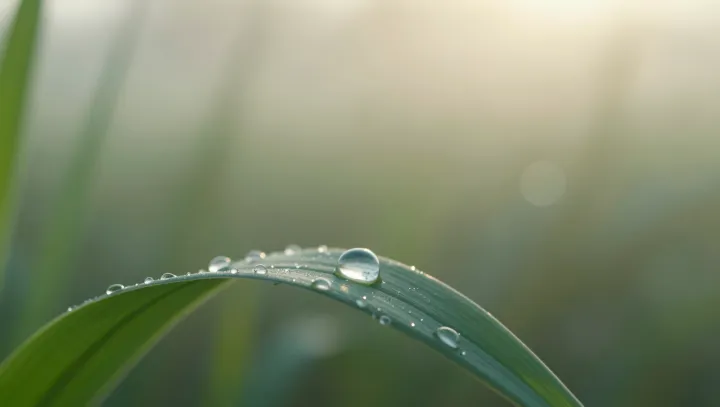
These beads are not glued. Along the leaf's rising curve, water gathers into rounded drops because surface tension pulls its molecules inward while the waxy cuticle offers little purchase, turning a garden image into a dispute between cohesion, adhesion, and gravity; the apparent decoration is a physical bargain, not a botanical flourish. Nothing is being placed.
Chemistry wins here. The cuticle, often topped with epicuticular wax, creates a low-energy, hydrophobic interface; water therefore meets it at a high contact angle rather than spreading into a film, a result that can make the leaf seem coated in polished glass. Cohesion takes over. Hydrogen bonds make water molecules favor one another, and their collective surface tension minimizes exposed area, so each drop rounds itself into the compact shape that requires the least surface energy.
Appearances mislead us. A drop can cling to a tilted leaf because microscopic texture and contact-angle hysteresis pin parts of its edge while gravity tugs downward, leaving it balanced rather than fixed. No glue is needed. Engineers borrow hydrophobic coatings for water-shedding materials, but those surfaces must contend with abrasion, contamination, and wear that a living leaf renews through growth. The leaf keeps its small argument with gravity, each bead a pause that daylight cannot explain away.