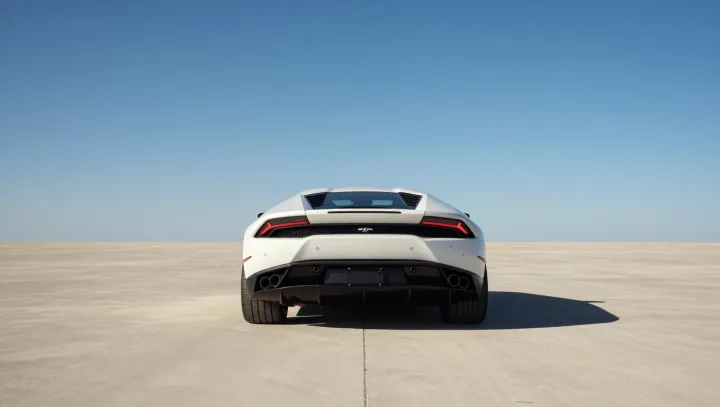
Heat leaves no mercy. Behind the cabin, where a Lamborghini places its largest mass and hottest machinery, slatted engine covers turn the rear bodywork into a pressure-managed vent, allowing heated air to escape rather than pool around the powertrain; the silhouette is less costume than an argument with thermodynamics.
Rear mass bites hard. In most such cars, the engine sits behind the cabin but ahead of the rear axle, concentrating mass near the vehicle's center and reducing polar moment of inertia; that sharpens rotation into a corner, while acceleration loads the driven rear tires and improves traction. The trade-off is severe. Abrupt throttle inputs can magnify weight transfer and unsettle rear grip if aerodynamic balance and chassis calibration do not keep pace.
Air must earn its keep. Louvres relieve underhood pressure and support convective heat transfer, while a rear diffuser accelerates underbody flow, lowers static pressure, and builds downforce through a controlled pressure differential; together, they help set a stable center of pressure when speed turns the body into a working surface. The four tips matter. They chiefly package exhaust flow and heat, yet their placement also keeps hot discharge away from panels and aero surfaces. A fast car survives by making its violence legible to the air.